Many people don’t know that an Italian-American from Delaware single-handedly saved our Union in 1776.
Okay, that may be a bit of a stretch.
Or is it?
Earlier this year I was reading a book called Italians in America – a volume unfortunately riddled with typos and, as far as I can tell, no small number of factual inaccuracies.
But one mention of a historical figure with Italian roots caught my imagination. The book briefly and almost offhandedly relates the story of Caesar Rodney, “the future governor of Delaware, who rode seventy miles through a torrential rainstorm, despite being stricken with cancer, to vote for independence in 1776.”
What???!
I needed to dive into this.
So I started writing a blog post about Caesar Rodney until a Washington Post piece about him appeared in March, at which point I dejectedly scrapped my work. But I’m changing my mind and resurrecting it now, because the WaPo story had a clearly different focus. So here goes.
***
Caesar Rodney was one of three Delaware delegates to the Continental Congress from 1774 to 1776. The Continental Congress was the governing body by which the 13 American colonies coordinated their resistance to the British Crown.
On June 7, 1776, Richard Henry Lee, a political leader from Virginia and one of our Founding Fathers, proposed a momentous formal resolution to the Congress declaring that the 13 United Colonies were “free and independent States” and no longer subject to British rule.
This idea was mind-blowingly radical and extreme. It would have enormous consequences for the Colonies. And there needed to be a unanimous affirmative vote to indicate a unified commitment to independence. Weeks of discussion, arguments, and wrangling ensued.
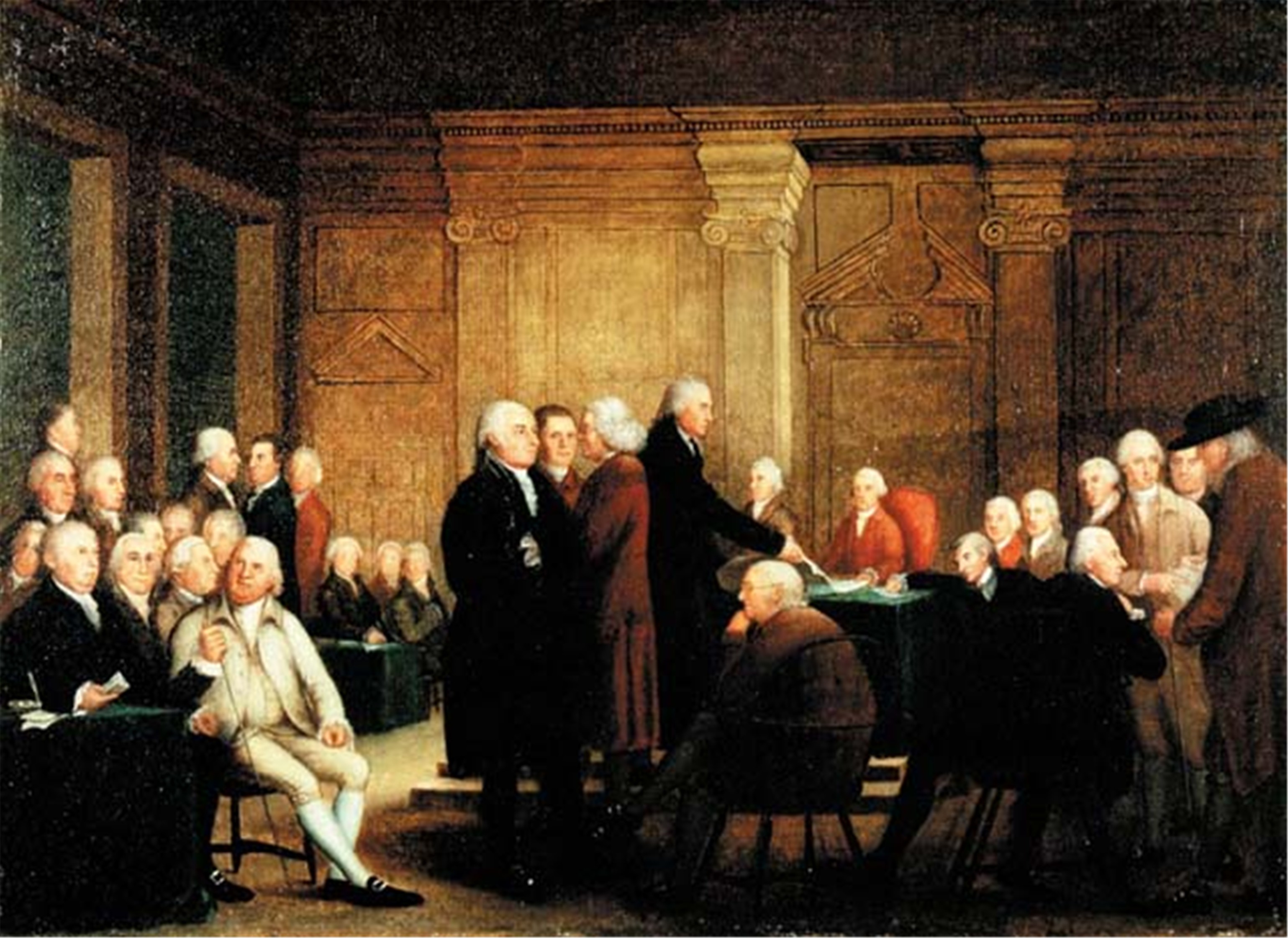
(painted by Robert Edge Pine and finished by Edward Savage)
When the voting for independence began in Philadelphia, there were holdouts. In the preliminary vote on July 1, nine of the 13 colonies supported the resolution. South Carolina and Pennsylvania said no. The New York delegates abstained because of a lack of guidance from their state. And Delaware was split in a tie between its two delegates who were present. Caesar Rodney, the third delegate, was absent; he was back in Dover working on military issues.
Everything was in chaos. The final vote would be held the next day. Word was that South Carolina and Pennsylvania would come around, but Delaware was at a stalemate. So it was sometime before midnight on July 1, 1776, that Caesar Rodney got word via an emergency courier that his vote was needed to break the tie for Delaware. He had to get to Philadelphia. And the only way to do that was by riding all night on horseback. But he was between 70 and 80 miles away (depending on the source) and, it turns, out, suffering from cancer.
***
Although his surname belies it, Mr. Rodney, according to my Italians in America book, was a man of Italian descent. I’ve since read that although he was mostly of English blood, he did have distant ancestors in Treviso (northeastern Italy, near Venice).
Born in 1728 in Kent County, Delaware, he was the oldest of eight children, and when he lost his father at the age of 17 he took over the family plantation and helped provide and care for his mother and siblings. He may have been a born leader, or he may have developed those skills because of his challenging circumstances. In any case, one of his brothers later described him as having a “great fund of wit and humor of the pleasing kind, so that his conversation was always bright and strong and conducted by wisdom.”
He was also, according to John Adams, “the oddest-looking man in the world; he is tall, thin, and slender as a reed, pale; his face is not bigger than a large apple, yet there is sense and fire, spirit, wit and humor in his countenance.”
Rodney was elected Sheriff of Kent County at the age of 27 and went on to a multitude of political, judicial, and military positions, including serving as an officer in both the French & Indian and Revolutionary Wars and as the fourth President of Delaware (akin to a state governor). But it was his heroic ride as a member of the Continental Congress for which he is most well known.
***
Most of us cannot imagine what that 18-hour journey would have entailed. I once rode a horse for two hours in the 1980s and came away with saddle sores and a raft of painful muscles for a week.
Picture yourself having hit the sack in your cotton nightshirt after a dinner of bacon, roasted meats, root vegetables, johnnycakes, cornbread, and some kind of fancy pudding like flummery. Maybe, in fact, you’re dead asleep. And suddenly you’re jolted out of bed by a harried messenger and are now staring an 80-mile ride in the face.
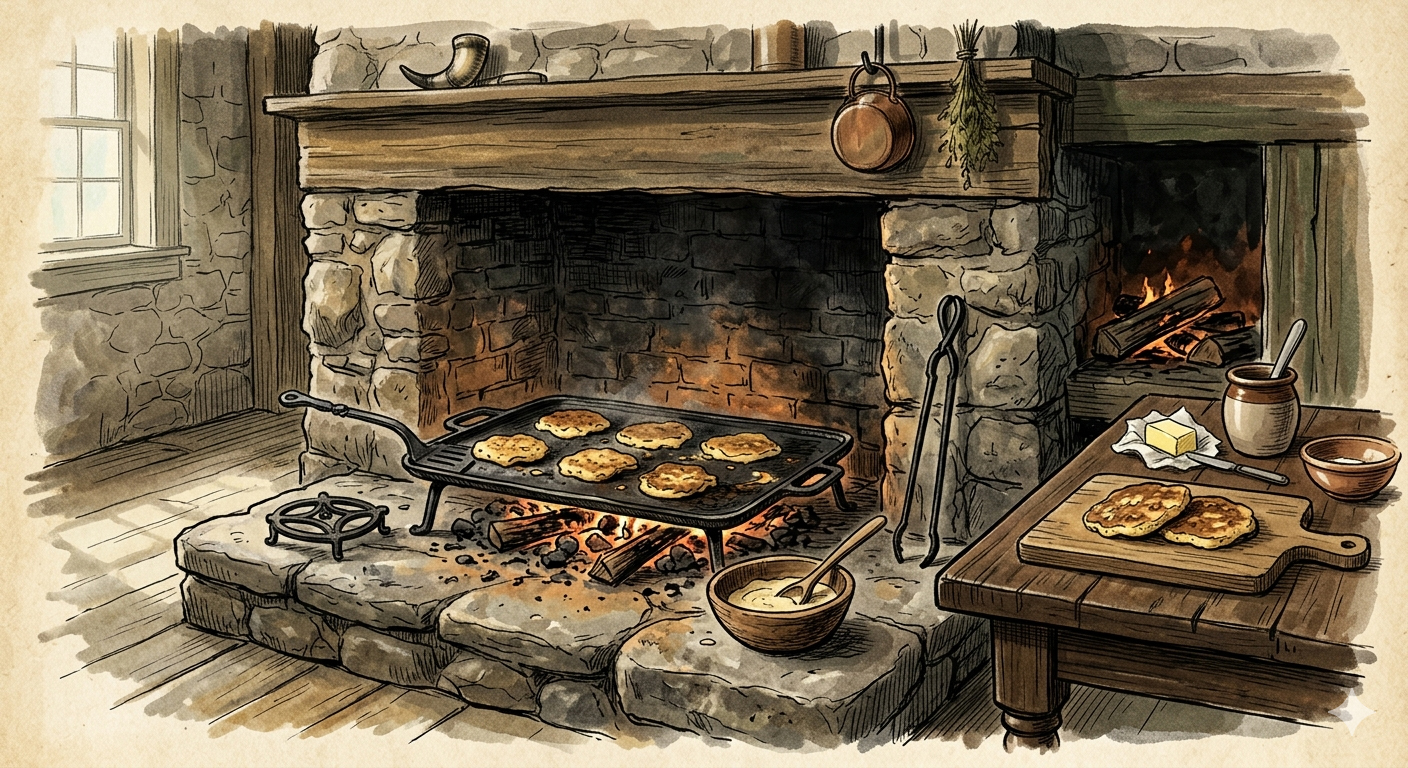

We know that Rodney used horses to get him to Philadelphia, although there is some uncertainty about the transportation details. Some say he rode all 80 miles on saddleback, while others believe he may have used a horse-drawn carriage for part of the ride because he seemed to indicate so in a letter he later sent to his brother. Also, a single horse typically wasn’t able to endure that kind of distance.
Either way, let’s consider the difficulty of Rodney’s ride. First of all, horseback travel was absolutely exhausting. And remember that there were no paved roads. The paths were narrow and treacherous, and of course there was the grave danger of falling, even in the best of circumstances.
But Rodney’s ride was through thunderstorms and mud. In a storm, downed trees might have littered the trails. From what I can tell, the moon was waning that evening, and the sky was black for most of the night. So he was thundering along rutted trails in complete blackness. Unseen hazards were everywhere.
Not to mention that apparently he had to cross about 15 rivers and streams!
How on earth did he even find his way?
Normally, saddle horses were switched out every 15 miles or so, and in a typical day an in-shape rider could last about 60 miles. Rodney, though, was heading towards 50 years old, suffered from asthma, and overall was in very poor health at the time.
Even if he did use a carriage for a portion of the trip (which would have slowed him down considerably), the ride was still potentially awful. In those days, in a rainstorm, a passenger often would need to get out and slog through muddy areas while the horses labored to pull the carriage. And were there multiple steeds available to him? We don’t know. In those days, sometimes there was an extra set of horses walking alongside a carriage that could then be used for later portions of the trip. But if not, even if there were inns along the way for resting and feeding the only set of horses, he made the trip so quickly that there had to be little time for that.
Bear in mind, too, that he was dealing with facial cancer, which involved years of grueling (and ineffective) medical treatment. It’s said that he often wore a scarf to hide his disfigured face. He may have had squamous cell carcinoma (just my non-medically-trained guess), which can be very painful, especially if pressing on nerves. (Today, his condition would be highly treatable.)
In any case, despite what had to be sheer misery, Rodney pushed through with that interminable, punishing journey.
Imagine being that selflessly committed to a noble ideal.
And he made it to Philadelphia on time, arriving “booted and spurred” and wet and muddy – and reportedly seriously ill – as the voting started. It was July 2, 1776. South Carolina and Pennsylvania reversed their choices to “yes,” New York still abstained, and Rodney cast Delaware’s deciding vote for independence. The resolution was unanimously approved by the 12 voting colonies.
On July 4, the Declaration of Independence was formally adopted, announcing, as Abraham Lincoln put it years later in his Gettysburg Address, “a new nation, conceived in liberty and dedicated to the proposition that all men are created equal.”
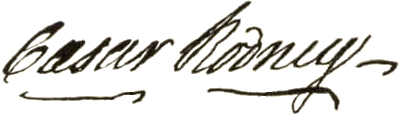
Caesar Rodney was one of the signers.
***
Rodney’s vote wasn’t necessarily a popular move in Delaware at the time because the majority party in the state wanted to reconcile with England, so he was defeated in the next election. But he’d voted his conscience.
Because of shifting ideologies, two years later he was elected President of Delaware (apparently a bit of a figurehead position in those days). He resigned in 1781, likely because of his poor health, but continued to serve in less-demanding capacities for the state until he died in 1784, at age 55, from complications of asthma and his long-time battle with cancer.
***
Little did I know, as I was just beginning research for this piece just a few months ago, that a controversy about a statue established in Caesar Rodney’s honor is playing out in real time.
The statue was erected in 1923 in Wilmington, Delaware, but it was removed six years ago because Rodney had been a slaveowner. It sat in storage until, in late April of this year, it was moved temporarily to Washington, D.C., as part of this summer’s “America 250” celebration.
Eventually it may find a new home in Kent County, which is where Rodney was born and where his historic ride started. But that’s not a certainty by any means. Many people have been pushing to just let the statue languish.
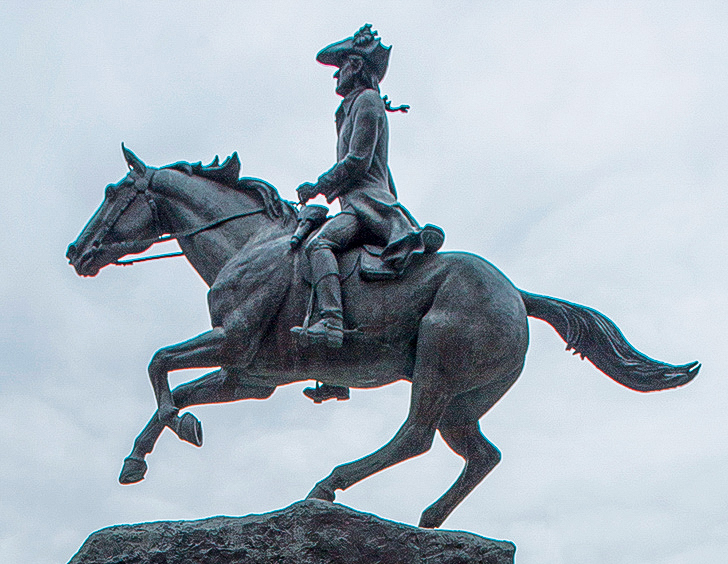
Delaware state senator Eric Buckson has been advocating for public restoration of the statue. “Without his midnight ride through the snow to break the tie,” Buckson believes, “we wouldn’t have July 4th as this country’s birth date.”
(Note: There was no snow in July. He probably meant “through a storm.”)
In an interview earlier this year, Delaware Governor Matt Meyer was more measured. “I have no problem [with the] Caesar Rodney statue being anywhere, as long as the history is told in a fair and equitable way,” he said. “Caesar Rodney was an incredible figure who helped to create the state of Delaware and our nation. That needs to be recognized. There are also things – Caesar Rodney held slaves, and there are things that need to be documented clearly any time we display a statue like Caesar Rodney.”
Rodney, indeed, owned slaves. But he changed his point of view over time and, full of remorse, ended up renouncing slavery. He also proposed bills, according to Delaware historian Richard Carter, that would have banned the further introduction of slaves into Delaware – a move that some argue presaged the later emancipation of slaves in this country. He also provided for the release of all of his slaves upon his death.
I understand why people don’t want to glorify anyone who participated in a dreadful practice like slavery. There are very few human beings today who would ever try to justify mistreating and owning other human beings.
Slavery also obviously contradicted the notion that “all men are created equal.”
I’m wondering, though, whether – as some have suggested – a biographical plaque that details Rodney’s life in its entirety could be installed on the base of the statue. That information would be meaningful to those who believe we should look at a person’s accomplishments within the entire context of his or her otherwise-flawed life. Apparently conversations about this are still being held in Dover and throughout the state of Delaware. There is no guarantee, though, that the statue will ever again be displayed in that state.
But there’s no denying the legacy that this man left, and the suffering he endured to do so.
The way I see it, Caesar Rodney helped save the Union.
He deserves a statue.
***
COMMENTERS, PLEASE NOTE: WordPress is no longer asking commenters for their names, so everyone is identified as “Anonymous.” If you’re commenting (which I love, PLEASE DO!), please leave your name if you’d like me to know who you are!
***
Due to popular demand, I am including, at the end of each blog post, the latest random diary entries that I’ve been posting on Facebook for “Throwback Thursday.” These are all taken absolutely verbatim from the lengthy diaries I kept between 1970 and 1987.
September 9, 1977 [age 21]:
“Tonight, I’m bored to tears. Our [dorm] hall is quiet again and I can’t bring myself to go seek out a party. So I’m lying around watching my face break out.”
November 8, 1977 [age 21]:
“[My dorm roommate, whom I didn’t much like] actually just got an apartment for next semester, and after she told me that, I played ‘Godspell’ on the record player and felt rather joyous.”

 Monday Morning Rail
I can only imagine the amount of research you did for this essay. And your efforts paid off — the essay is excellent.
LikeLike