

“It’ll cost you $3,200,” the mechanic told me.
Oh, no, it won’t.
That moment marked my emergence from total ineptness into an expert mechanic and true Queen.
***
Let me back up.
(Well, I’m terrible at backing up, but we’ll get to that in a moment.)
My Thunderbird’s “Check Engine” light appeared a couple of months ago. These kinds of things always unnerve me, so I immediately scratched around for my manual and learned that a solid (as opposed to blinking) light indicates a problem with the car’s emissions system.

I’d bought my T-Bird in 2001, entranced by its retro design – a throwback to the 1950s. To avoid the prohibitively long waiting lists and outrageous dealer markups in California, I picked up the car in Versailles, Kentucky, and drove it home along Route 66. The trip was a dream, full of nostalgia and reverie.
Now, more than two decades later, I don’t drive the Thunderbird much. It’s a two-seater convertible with no room for our dog, it lacks modern bells and whistles (like the life-changing “blind spot warning”), and it’s showing its age. But I’ve insisted on keeping the car, mostly because it costs almost nothing to insure, I put almost no money into maintaining it, and I believe that it’s always good to have a second vehicle in case of emergency. Plus it’s beautiful and fun to drive. So I dutifully take it out for a short spin every other week, and that’s the end of it.
Until that “Check Engine” light came on.
***
I decided to take my car to the dealer, even though it would cost me $270 just for a diagnosis. I know, I know, the standard advice is not to use a dealer for repairs. But I didn’t have my own mechanic, and I was really distressed by the idea that my poor engine needed checking.
When the mechanic called, he said that he’d done a “smoke test” that had detected some leaks near the fuel pump assembly at the right side of the fuel tank. He’d have to replace the fuel pump and some other things and, if that didn’t solve the problem, he’d need to replace the fuel tank. Otherwise, I wouldn’t be able to pass my next smog check.
“And it’ll cost you $3,200,” he said.
I stood in shock for a few seconds. Then I wavered, not wanting to hurt his feelings, like not wanting to tell a doctor that I needed a second opinion. But I came to my senses.
“No, thank you,” I finally said.
“What do you mean?”
“No, thank you,” I repeated. “I’m going to need some time to think about this.”
I wasn’t sure what I was going to do, but I knew I didn’t want to consent to shelling out $3,200 right then and there. I could feel an ulcer sprouting.
“Well, it’s going to take me a long time to get this car put back together,” he told me, seemingly annoyed. “I might not be able to do that until tomorrow.”
“Oh, that’s no problem,” I answered cheerily. “I don’t drive the car all that often, so feel free to keep it just as long as you’d like.”
Amazingly, about 45 minutes later he called to tell me the car was back together and ready to pick up.
So I returned to the dealership, and that’s when things began to get a bit interesting.
I was the only customer in the pickup area, and the cashier struck up a conversation with me. It turned out that he was a Thunderbird collector, and he’d grown up in San Francisco, so we had a lot to talk about. I patiently listened to all his stories, laughed at his jokes, and in general commiserated with him about the state of the world. As he was about to finally take my credit card, he asked, “By the way, how much did the mechanics say they’re going to charge you for this repair?”
“$3,200,” I told him.
And this man, who stood not 20 feet from where the mechanics were working, and who worked for the dealership, told me, “That’s ridiculous. It shouldn’t cost nearly that much. Take it to another mechanic and see what they say. If you have a leak, they might be able to just patch it. And if it turns out that they do have to replace the fuel pump, believe me it won’t cost $3,200.”
I was stunned. And I was worried for him. What if someone overheard? What if his bosses had cameras monitoring him?
I thanked him profusely, got his business card, paid my outrageous $270, and left.
I needed to find a mechanic.
***

A Yelp search convinced me to try DAS Auto Service – a repair shop in Daly City, about 15 minutes away. The reviews said that the mechanics were fair, respectful, honest, and reasonable.
When I brought the car in, I didn’t say anything about the Ford diagnosis because I wanted their employees to approach the problem with no preconceptions.
A couple of hours later, the main mechanic, Lalo, called to say that my gas cap looked a little worn and that he thought we should start with replacing the cap, in case that would fix the emissions problem. The total charge would be $28.
Whaaaaaat???
***
For a few weeks I thought it was absolutely inconceivable that a dealer would have given me a fake diagnosis and would have tried to charge me $3,200 for a $28 repair. I was convinced, in fact, that the “Check Engine” light would reappear.
But it didn’t.
When I texted my Iowa friend who also owned a T-Bird and had a lot of experience with cars in general, he told me that dealers always see women coming. If they’re alone, they’re about to be gouged.
I really hadn’t considered that. I’m typically the last person to blame any kind of “ism” or phobia for the way I’m treated.
Later I told my sister this story and she said, “Oh, yeah, I never go into a dealership. I always just send my husband.”
***
But the real test – part 2 of this saga – was still to come.
California cars more than eight years old must pass a smog check every two years. And my T-Bird was due. If it passed, I’d know with certainty that the new $28 gas cap had fixed my emissions issue.

But this brought up another pain-in-my-side problem.
If its electrical system has been recently reset, my car cannot immediately be accepted for a smog check. Crazily, it has to be driven many miles so that several internal tests can be completed before it is “smog-check ready.” (This is apparently the case for many cars.)
Typically, after something like a battery change, I’ve been told to drive for 50 to 100 miles at a steady speed kept strictly between 50 and 55 mph in order to reset the car. But that’s never proved to be enough miles. And to make matters worse, there’s absolutely no visual indication of when the car is finally “ready.” So I’ll drive 100 miles and make my smog check appointment, only to hear the mechanic tell me that nope, the car is not yet ready. When my last battery was installed two years ago, I made three appointments, driving at least another 50 miles between each one, only to be turned away every time. On the fourth try, I asked Julie to do it. I just couldn’t take the shame and embarrassment. That time, my car was finally ready (and it passed, of course).
I knew that the mechanic had had to reset the electrical system when he cleared my “Check Engine” light, so as a preemptive measure I took the T-Bird out on the freeway twice, logging a full 150 miles. But nope, at my appointment I was told that the car wasn’t ready.
“Nooooo! This is so embarrassing for me!” I wailed at the smog guy. “I have to keep making appointments and wasting your time, and I have no way of knowing when my damned car is finally ripe for the testin’!”
“That’s true,” he said. “Unless you have one of these,” he tossed out as an afterthought.
He held up a gizmo.
I didn’t ask any further questions, but I thought about that gizmo all the way home.
***
I’m no mechanic and I’m completely inept, but what if I had my own gizmo and could do my own pre-testing?
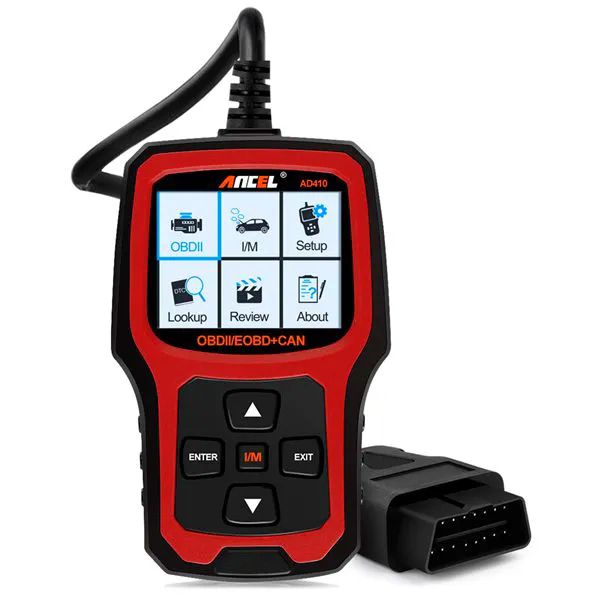
“Gadget that indicates whether car is ready for smog check,” I typed into Google, and eventually I identified the device. It’s called an OBD2 scanner. Not only can it diagnose warning light issues, it also has a dedicated button that conducts a 5-second test to determine whether the car is smog-check ready. AMAZING! What a lifesaver! What an embarrassment saver!
And it costs only $40!
When my wonderful scanner arrived, I decided to plug it into the car immediately to make sure I knew what to look for. This was no easy task. There was no visible receptacle, so of course I turned to the Internet again. There I found a nice set of specific directions for the T-Bird that involved blindly reaching under the dashboard, groping around, and . . . voilà! There it was!
Of course, I needed to be able to see the receptacle to connect the scanner, so I grabbed a flashlight and then had to lie on my back and crawl backwards like a crab while squeezing my skull under the dashboard. (Thank goodness I have a pinhead.)
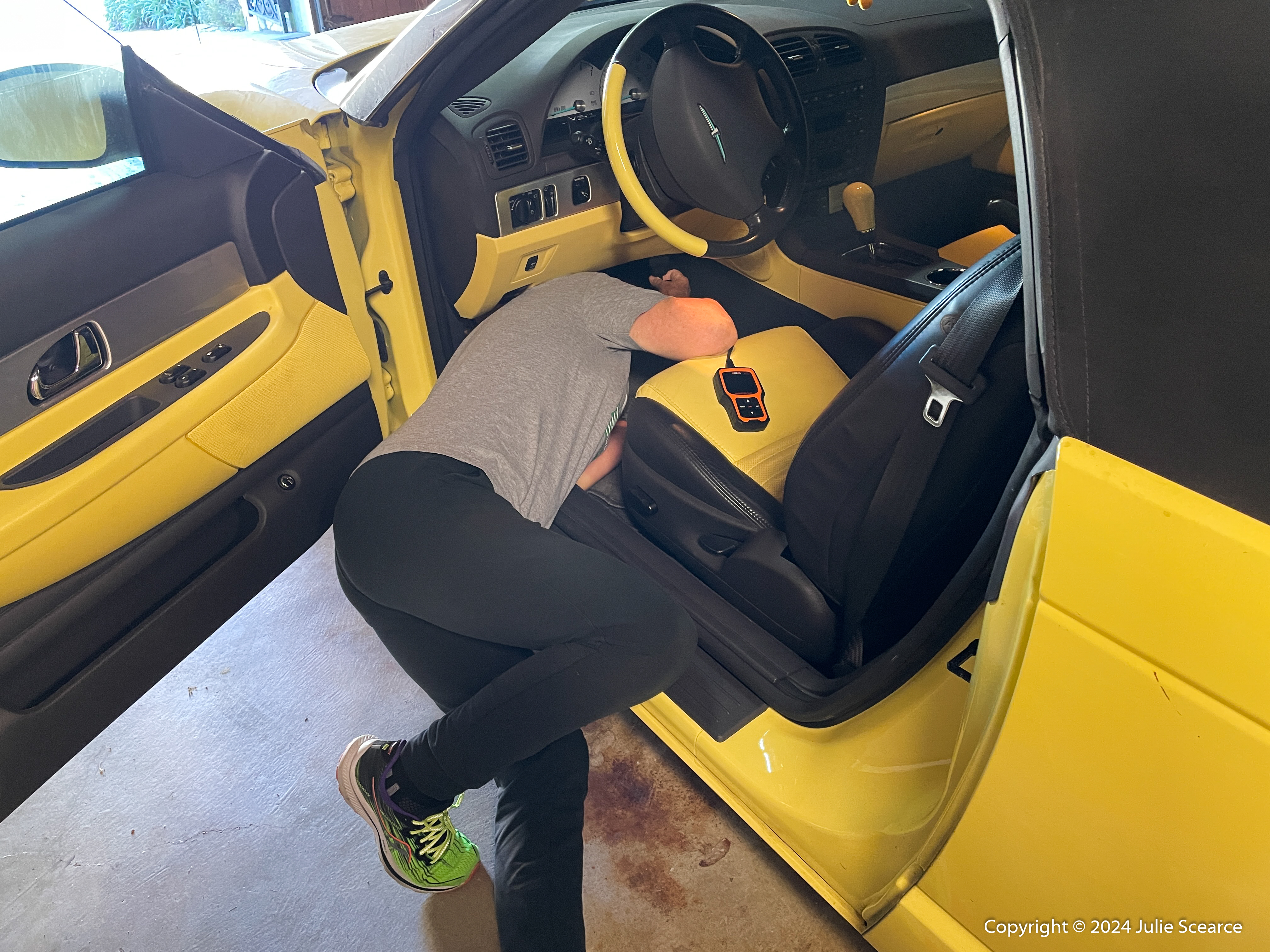
I made the connection, turned on the ignition, and voilà! – the scanner displayed a big red “X” rather than a friendly green check.
So I decided to drive another 80 miles, which would mean heading south almost to San Jose and back. Even in the slow lane, cars do not take kindly to someone driving 50 mph and I’m on edge the whole time, clenching both the steering wheel and my teeth and maintaining a full sweat.
Sensing my anxiety, Julie helpfully suggested that I head out at the crack of dawn on Sunday morning, when there’d be fewer cars on the road. Brilliant.
By the way, I’m a great driver. I’ve never in my life had an at-fault accident or a moving violation. I can parallel park like a seasoned pro. But I have to admit that I cannot back a car up skillfully to save my life. And my T-Bird is a big vehicle. Without a rear camera. That Sunday morning, it took me eight tries to back out of the garage. Drive partway out and then drive back in, drive partway out and then drive back in. I actually prayed. But at least it was so early that no one in the neighborhood saw me. And I figured no one in my household would ever have to know.
Eventually I made it out onto the street successfully and had a lovely drive. I didn’t see a lot of cars. Only one honked at me.
A few of my many attempts to back out of the garage
I’d now put about 230 miles on the engine since the system reset.
I got home, held my breath, and once again plugged in my sweet little gizmo.
The CAT light was now a friendly green.
SUCCESS! HALLELUJAH!!
The scanner also showed that I had no DTCs (Diagnostic Trouble Codes, for those of you who aren’t expert mechanics like I had become). This was surely good news!
A little while later, I noticed that I had multiple security camera notifications on my iPhone. I’d forgotten that we have a camera in the garage. Uh-oh. Busted! There were eight videos of me trying to back that damned car out.
***
I made my smog check appointment and sat in the waiting room nervously. Was the car finally ready, as my trusty new OBD2 seemed to indicate? Would the guy find a leak?
I didn’t eat that morning, for fear of getting a stomachache.
But after only about 15 minutes I got the news. My car had passed!
***
The Ford people had sent me at least three e-mails asking me to fill out an online survey about their “work,” and now that I had absolute proof of their gouging, I rushed home to fill out the survey. But to my dismay, it had expired.
I did leave a vicious review on Yelp, however.
That night, I lifted a glass of wine in toast to my triumph. I’d learned to avoid repairs at dealerships. I’d found a glorious new mechanic. I’d successfully used an OBD2 that would forever eliminate my smog-check shame and embarrassment.
I was now firmly in the driver’s seat.
***

COMMENTERS, PLEASE NOTE: WordPress is no longer supporting my particular page type and doesn’t seem to be asking commenters for their names, so everyone is identified as “Anonymous.” If you’re commenting (which I love!), please leave your name if you’d like me to know who you are!
***
Due to popular demand, I am including, at the end of each blog post, the latest random diary entries that I’ve been posting on Facebook for “Throwback Thursday.” These are all taken absolutely verbatim from the lengthy diaries I kept between 1970 and 1987.
November 3, 1975 [age 19]:
“I’m thinking that someday I may really be able to get something published, something resembling the Great American Novel. Maybe not. But the idea of writing doesn’t depress me any more; I’m neither a pessimist nor an optimist. I enjoy it, and if I find myself in print someday then all the better. If not, well, I’ll be a famous detective.”
November 4, 1975 [age 19]:
“Hey, my birthday will be coming up soon – I’ll no longer be a teenager. It scares the almighty crap out of me.”
November 6, 1975 [age 19]:
“I had a really nice time tonight – around 5:00 or so I went to pick up [my friends] Mary and Carolyn and we went to visit [our incredible high school Spanish teacher] Mrs. Giannini. First we ate out at this tiny Japanese restaurant nearby called Kozy’s Chinese Cuisine. Mary and I split half a bottle of wine and got really giggly. I was telling all of my crazy dumb antics – I’ve really got to write a book about them. I stuffed myself and in addition to my own dinner I ate Mary’s prawns and Carolyn’s french fries.”
[Ed’s note: why on earth did I think Kozy’s Chinese Cuisine was a Japanese restaurant?]
November 11, 1975 [age 19]:
“I had my last midterm today, and it was in my film class – the one class I have which is anything akin to what I expect a university class to resemble. Surprisingly enough, although I studied for only about 1 hour total, having allocated an entire day but wasting it, I think I did fairly well. I just happen to be tremendously lazy, but despite my laziness I always manage, somehow, to do JUST ENOUGH studying. [My brother] Marc came by [to the dorms] tonight, and by unluck I was chosen to go procure the Togo’s family-size pastrami sandwich that we had for dinner. [My roommate] Sally and I got in a thousand scraps over who’s to pay the phone bill, over her eating my breakfast bars, and over her fooling around with my stereo. She’s so maddeningly illogical! Anyway, I celebrated my release from midterms with about 3 ounces of Sambuca. Then, at Sally’s mere mention of her craving for jelly doughnuts, I suggested in drunken spontaneity that we simply go to Winchell’s and satisfy her desire. So we did, and now it is 12:15 a.m., and here we are eating doughnuts and drinking tea. Such is life. Can you tell I’m feeling my three Sambucas, future Paula?”
November 12, 1975 [age 19]:
“I just got back from seeing ‘Satyricon,’ a Fellini film, and it was so horrible and depraved that it tightened up my insides and now I have a murderous stomachache.”
November 19, 1975 [20th birthday]:
“It was pretty much a great day, at least in terms of getting attention. At work I got a cake, and a beautiful turquoise necklace from [my co-worker] Terrie with a joint under the ribbon on the box (which I quickly concealed in my wallet). I had dinner with the family: gnocchi, steak, broccoli with cheese sauce, wine, and pie. Mom and Dad gave me a good hairdryer and [my siblings] got me three Eagles albums. Grammy was there and gave me her usual $5. At 9:00 I got back to the dorms and we had a grand old alcohol party with Sambuca and champagne and cold duck and all got smashed. [My roommate] Sally was there, and my sweet dormmates Jack and Ken and Art and Lydon and Dave. Jack gave me a birthday kiss that sent me reeling.”


 Monday Morning Rail