Into that good night

Into that good night

Julie and I have celebrated a couple of milestones over the past few weeks. I’ll save the more monumental one for later and begin by noting that June 23 was our 10th official wedding anniversary. We’ve really been together more than 20 years, but it was June 23, 2008, when we scrambled to get married in the brief window of opportunity afforded us before California’s (short-lived, thankfully) Proposition 8 yanked that privilege away. The ceremony took place at City Hall on a Monday, which I know is an odd day but it all happened in a rush and people all around us were hastening to tie the knot. There was no time, really, to plan anything large and elaborate, so we gathered at a suite at the Fairmont Hotel for our small reception. I chose that establishment because to me it embodied old San Francisco, and I was grateful to the City in so many ways for the rich, fascinating, and happy life it had provided to me.

So my plan, 10 years later, was to surprise Julie with a return to the Fairmont.

***

It didn’t go exactly as planned, and I blame our dog Buster. Of course, he has no idea about his part in this. I had thought through all the details meticulously, calling the hotel directly instead of making online reservations just in case Julie were to see something on my computer, and arranging months in advance (by text) for our trusted dogwalker to board Buster. My chosen restaurant didn’t take reservations (ensuring that Julie couldn’t see any confirmations on our OpenTable account) but was open steadily from 11 a.m. on, so we could waltz in for a meal in the late afternoon and likely have no problem being seated. Tutto a posto, as they say in Italy. Everything was in place.

But not so fast.

Just a few days before June 23 arrived, our dogwalker’s husband informed her that they had a wedding to attend in southern California. And when she called to tell me the news, I idiotically answered the phone as Julie sat in the same room watching television. “Hi, Louise!” I said brightly before noticing Julie’s puzzled look. I then proceeded to splutter all kinds of nonsense into the phone as I tried to figure out a way to be covert. It soon became obvious to all concerned that the jig was up, and ultimately I had to confess my plan.

Of course, we then had to scramble to figure out where to leave our dog for the night. We don’t do kennels because Buster considers himself far too regal for cages. I thought of asking a neighbor but didn’t want to impose Buster’s quirky, barky little personality on anyone.

Finally, in desperation, I texted our former dogwalker – who now lives in New Orleans! – and bless her heart she did some long-distance liaison work and found us a substitute. All was well again.

***

For those of us who have lived in San Francisco for most or all of our lives, the City these days can be a difficult place to navigate, both physically and emotionally. Its changes have been monumental. I’m going to save my thoughts on that for another day, though, because for our anniversary I wanted us to honor, cherish, and celebrate some of the very oldest, and most respectable, places in town. Checking into the Fairmont would begin our tribute.

Flags outside of Fairmont - from Fairmont site

The Fairmont is not the oldest hotel in San Francisco – the Palace Hotel holds that distinction – but it is one of the few grand pre-Earthquake survivors. When the Big One hit in April of 1906, the building’s structure was complete, the rooms were about to get their finishing touches, and the hotel was about to open its doors to customers for the first time. The Fairmont was one of the “Big Four” hotels on Nob Hill that were named after three of the era’s Big Four railroad tycoons who built the Central Pacific Railroad: Leland Stanford (the Stanford Court), Mark Hopkins (the Intercontinental Mark Hopkins), Collis Potter Huntington (the Scarlet Huntington), and Charles Crocker (Crocker didn’t get a hotel named after him, although what is now the Westin St. Francis was supposed to be called the Crocker Hotel). The Fairmont had no ties with the railroad business but was named for sisters Jessie and Virginia Fair, the original owners who wanted to build a monument to their father. Nob Hill, around which all four hotels were built, was so named because the Big Four railroad men had been given the moniker “The Nobs.” (A nob is a nabob, or “a person of great wealth or prominence,” according to Merriam-Webster. Remember when former Vice-President Spiro T. Agnew referred to the “nattering nabobs of negativism”?)

After_earthquake_and_fire_(1906)_(14576452280)
The Fairmont stands tall amidst the rubble, 1906

Anyway, although everything around it was reduced to rubble after the Great Earthquake and Fire, the Fairmont Hotel stood like a heroic, indestructible symbol of the resilience of San Francisco. As the writer Gertrude Atherton said at the time, “I forgot the doomed city as I gazed at The Fairmont, a tremendous volume of white smoke pouring from the roof, every window a shimmering sheet of gold; not a flame, nor a spark shot forth. The Fairmont will never be as demonic in its beauty again.”

Stanford White
Stanford White

Before I leave the Fairmont’s story, I must note how San Francisco’s colorful history was exemplified in the refurbishing of the damaged hotel. The first choice for an architect to repair and redecorate the Fairmont was one Stanford White, a New Yorker with a ridiculous moustache who nevertheless was well respected for his use of Beaux Arts design principles. The moustache did not, apparently, prevent his being a bit of a tomcat because he was dining pleasantly during a show at Madison Square Garden on the evening of June 25, 1906, when he was shot dead by millionaire Harry Thaw over White’s relationship with Thaw’s wife. Ironically, the murder occurred during the show’s finale, “I Could Love a Million Girls.”

Julia Morgan-2
Julia Morgan

With Mr. White permanently out of commission, the hotel’s owners – quite progressively – then brought on Julie Morgan, who in 1904 had become the first woman licensed to practice architecture in California. Another aficionado of the Beaux-Arts style, she was later to become the principal designer for Hearst Castle. Morgan was apparently chosen because of her knowledge of earthquake-resistant, reinforced concrete construction, and after supervising every aspect of the job for 12 months with very little sleep, she was able to preside over the reopening of the Fairmont exactly a year after the earthquake.

The place is spectacular. The Charter of the United Nations was drafted and signed at the Fairmont in 1945, so the flags of the signatory countries still fly to this day at the front entrance. The grand and flamboyant lobby welcomes guests with ornate Corinthian pillars, marble floors, and gilded ceilings. The hotel’s Venetian Room is the lush showroom in which Tony Bennett first sang “I Left My Heart in San Francisco.” The Laurel Court restaurant sits under three domes and is a dashing remnant of the past. The tiki-themed Tonga Room & Hurricane Bar, a charming blend of kitsch and sophistication, is just a barrel of fun, with coconut-sized tropical drinks, an indoor lagoon and floating stage, occasional “rainstorms” complete with thunder and lightning, and a dance floor that was originally the deck of the S.S. Forrester, one of the last of the tall ships that sailed the south seas. And the city views from the Tower rooms are, in a word, stunning. Outside lie the Golden Gate and Bay Bridges, the vast cityscape of San Francisco and, right below your bedroom window, little cable cars climbing halfway to the stars.

051_2018_06-23_10th anniversary_Night view from Fairmont room 18
View from our room

***

Dinner that afternoon would be at the Tadich Grill, and we could get there easily by cable car. Because both of us are generally ravenous by 3:30 p.m., I knew that the restaurant’s no-reservations policy would not be a problem, even in the middle of tourist season.
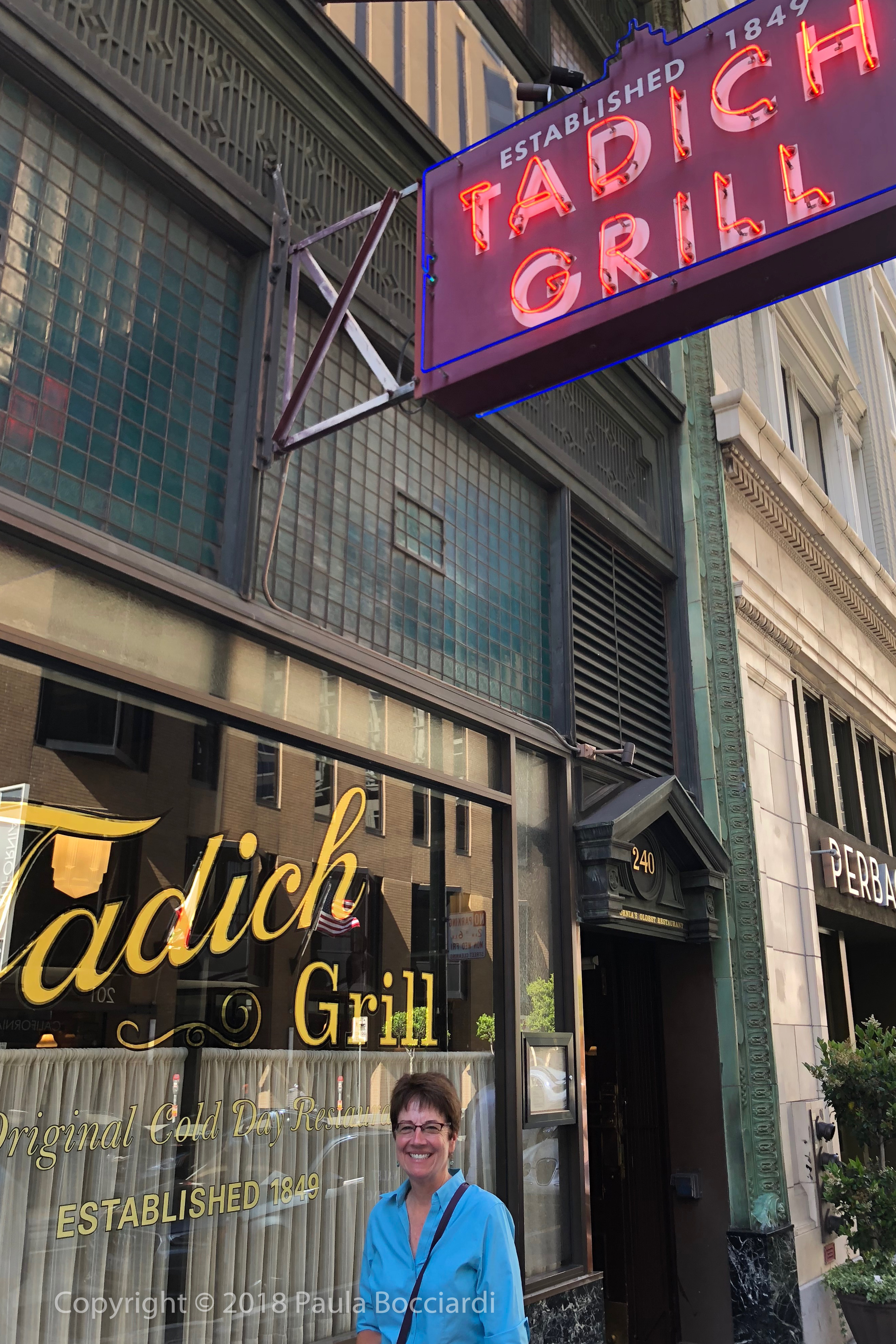
026_2018_06-23_10th anniversary_Tadich Grill sign_Paula

Tadich Grill, founded in 1849, is the oldest restaurant in California. It also happens to be two doors down from 260 California Street, where I worked for much of the 1980s. My very first job out of college had been as a production assistant at Harper & Row Publishers, but when the parent company moved its textbook division back to New York, I was suddenly out of a regular job. Thus began my seven-year stint as a freelance copy editor, during which time I worked periodically at the Institute for Contemporary Studies (ICS), a nonprofit think tank and publishing house. This was during the halcyon days of working in downtown San Francisco. We’re talking short hours, midday martinis, spirited political discussions, expensive vendor lunches, and lots of drama among us young employees. Every day at 11:30 a.m., like clockwork, the thick, smoky aroma of Tadich’s grilled steak made its way through the open windows. It was exquisite and torturous and a sensory memory I’ll never forget.

Tadich is primarily a seafood restaurant, though, and Julie and I both ordered fish in one form or another. Julie chose the seafood sauté and I was reminded of the first time we had dinner together 23 years ago, at McCormick & Kuleto’s in Ghirardelli Square. Although she is from Kentucky and had never eaten a mollusk in her life, she ordered the seafood cioppino, threw on a bib, and dug with gusto into a messy bowl of Dungeness crab, mussels, clams, squid, shrimp, and who knows what all. It was most impressive.

I love the old, rich look of the Tadich Grill. Dark wood fills the interior. A mahogany bar extends almost the length of the restaurant. The booths are set back into individual dark alcoves that must have seen many a clandestine meeting of one sort or another. The lamps are antique brass. Everything is polished. And on each white-clothed table, waiting for diners, sit a bowl of lemon quarters and a basket piled high with authentic, chewy sourdough – not the namby-pamby stuff that supposedly passes for bread these days.

TadichFry-800x496
Hangtown Fry

I pondered ordering one of the local specialties, like the Crab Louie or perhaps the Hangtown Fry (an omelet made with bacon and oysters), which has been on the menu for almost 170 years. Legend has it that the dish was created when a successful Placerville gold prospector asked his hotel proprietor to serve him the most expensive meal possible. The three priciest foods at the time were eggs, bacon, and oysters, which had to be brought to Placerville on ice from San Francisco, more than a hundred miles away.

Ultimately, though, I settled on my perennial favorite, petrale sole.

“Would you recommend the mesquite-grilled or the pan-fried?” I asked our white-coated, black-tied waiter.

He gave me a smirk. “Do you want healthy,” he asked, “or do you want tasty?”

***
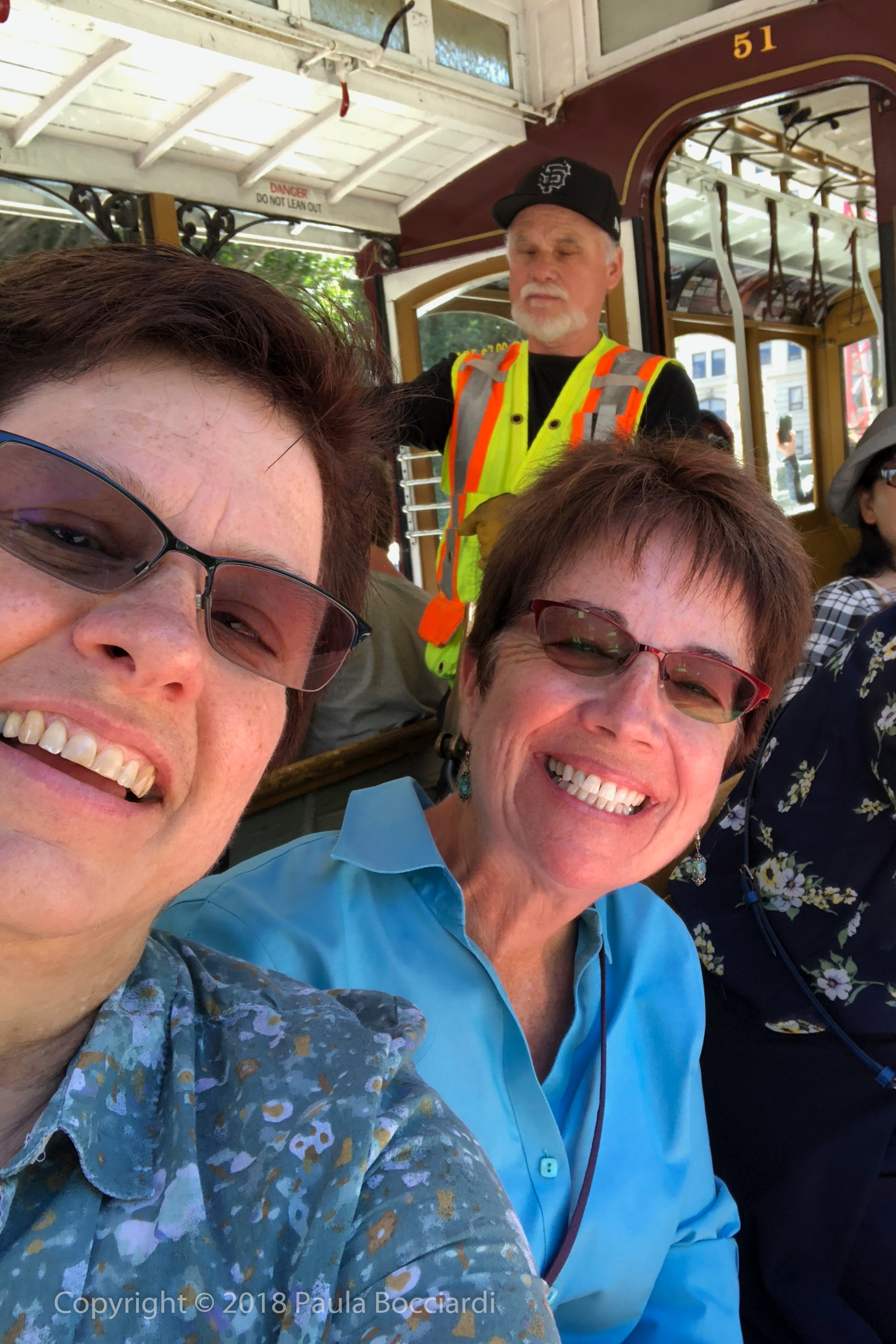
025_2018_06-23_10th anniversary_Cable car_Julie, PaulaTo cap off the evening it seemed appropriate that we hop a cable car back up California street to the Top of the Mark, the glass-walled penthouse lounge on the 19th floor of the Mark Hopkins hotel. San Francisco’s cable cars are part of the last manually operated cable car system in the world. Only three lines remain, and the California Street line, established in 1878, is the oldest. We clanged our way towards Nob Hill, rumbling and lurching along the track. It’s a hard job to manually operate the levers controlling the car’s movement along the cables. It was an uncommonly balmy evening, and the gripman pulled and sweated and cursed.

Since 1939, the Top of the Mark with its 360-degree view of the city has been a destination for tourists, entertainers, sailors, soldiers, and natives. Some say that during World War II, soldiers would buy a bottle of liquor and leave it with the bartender so that the next guy from that squadron to visit the establishment could enjoy a drink – a practice that remained ongoing as long as whoever had the last sip bought the next bottle.

A man and woman with thick Georgia accents sat behind us. He was dressed rakishly, and she wore a hat. “We had no idea we’d be here in San Francisco on such a special weekend,” the woman said, warmly. It was Gay Pride weekend, but Julie and I had stayed away from all the events this year. We go to the parade every once in a while, but it takes fortitude to stand on Market Street for 8 hours. I’m not kidding about the time frame. Sometimes half an hour goes by between floats. I don’t know what it is but gay people can be extremely disorganized.
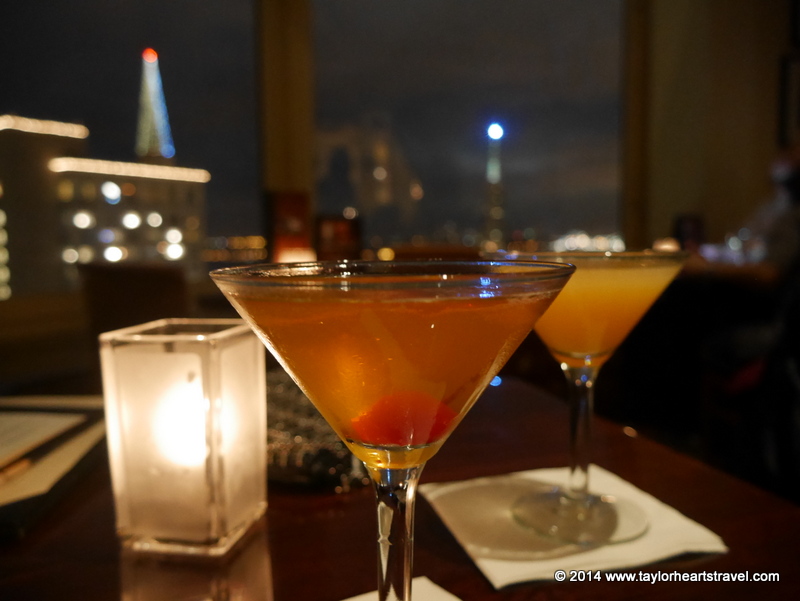
Top-of-the-Mark-56Julie ordered a tropical cocktail called the “Bay Bridge” and my choice was the “Indonesia Nu Fashioned,” a mixture of Woodford Reserve Distillers Select Bourbon (my nod to Kentucky), dark crème de cacao, and Angostura bitters served on the rocks. I gave it a stir and gazed outside at the breathtaking view.

“I wish I were wild and elegant like that Georgia lady,” I said, a little regretfully.

The sky was clear over Nob Hill as we headed across the street and back to the Fairmont, but fog was drifting in slowly from out past the Golden Gate. Julie said that to her the fog in San Francisco is like a blanket, always there to tuck us in at night.

***

Three weeks have passed, and today marks the other milestone for us.

Today is the first day of Julie’s retirement.

Last Friday – her final workday ever – we went downtown, dropped off her work computer, turned in her badge, and drove out to the beach to have lunch at the Cliff House, another venerable SF institution. It’s a place where we’ve celebrated significant events in our lives. We’d gone there after we applied for our marriage license, on the day the CA Supreme Court granted us that privilege. We’d eaten there on the day I retired, nearly 5 years ago. And now this. A comfortable fog hung over the surfers. Julie said it was perfect.

There is, of course, no telling what the future has in store, and whether this new freedom of ours will last for one day or 20 years. With the liberation of age comes the restriction of physical changes. The body is often sore for no reason. Despite all efforts and all manner of exercise and healthy eating, the bones grow tired and the muscles get weaker.

There are times when I rue the fact that I now glide through my days unnoticed. Darn it, I want to be appreciated, respected, and even heralded, like the Fairmont, Tadich Grill, the Top of the Mark, the Cliff House, and the cable cars that manage to keep on rumbling up the hills.

Maybe I am like the San Francisco of old. Some of me is weathered, some of me is gone completely, but other parts still stand resolutely. And there are promising days ahead. There will be more causes for celebration. There will be good food and wine and laughter. There will be beauty and unexpected discoveries. There are trains to be taken and there is music to be played.

A new chapter starts now. I want healthy, but I also want tasty. I will not go gently into that good night.
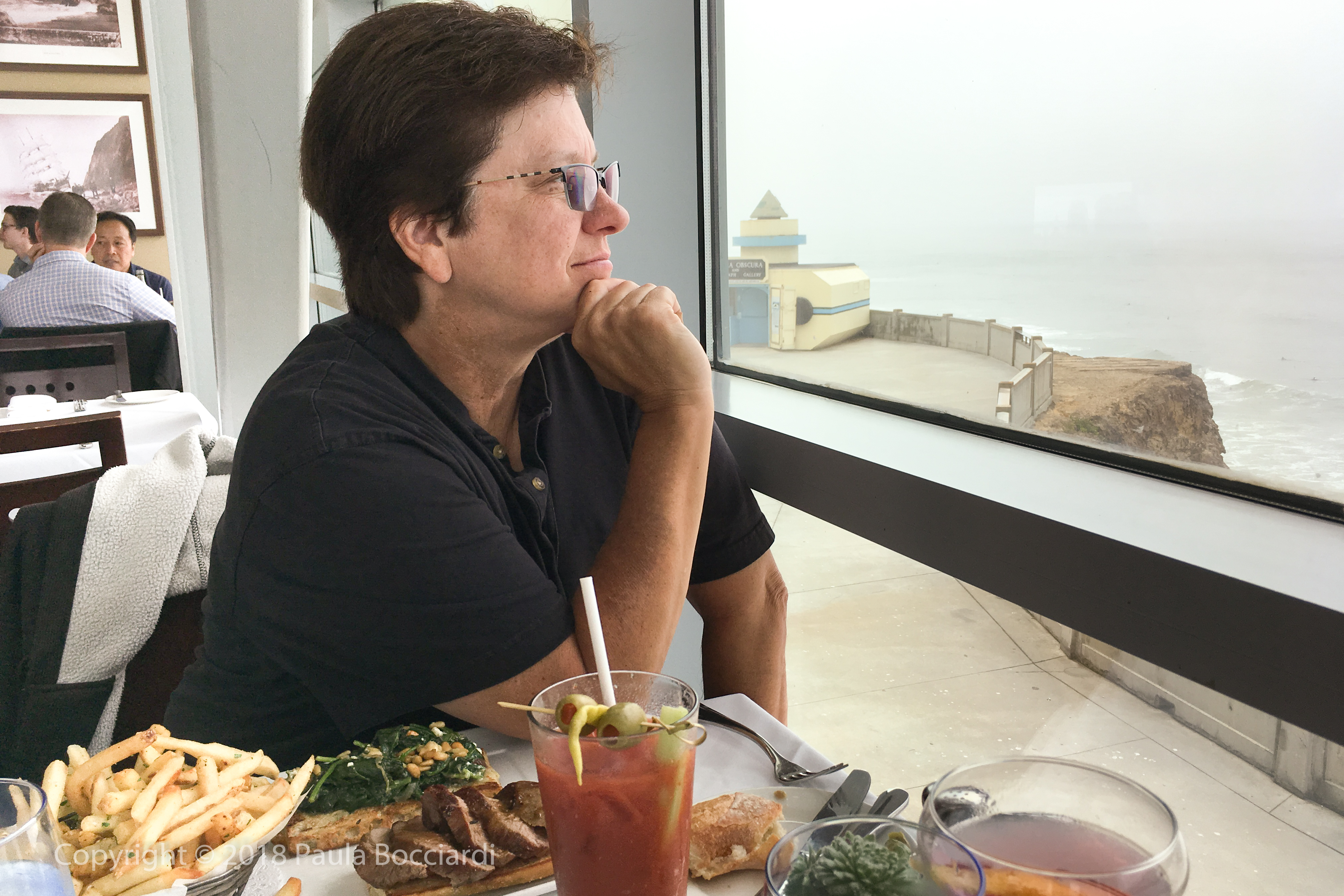
2018_07-13_Julie's retirement day_Julie at Cliff House window 2
At the Cliff House, Julie ponders what on earth she’ll do in retirement

***

Due to popular demand, I am including, at the end of each blog post, the latest random diary entries that I’ve been posting on Facebook for “Throwback Thursday.” These are all taken absolutely verbatim from the lengthy diaries I kept between 1970 and 1987.

2/21/71:

“I went to see LOVE STORY today and was a bit disappointed, mainly because of the buildup I had been getting from other people. When the girl died, I cried one tear and that’s all. It wasn’t that good. Then I went to Colleen’s and they took me out to eat at MacDonald’s. Now, I am sitting here sniffling as the after-effect of the hay fever attack I got over there. Know why? Well, because they have lots of hay, of course.”

2/1/71:

“What has been occupying my thoughts partly lately has been a sorry feeling for my teachers – three in particular. Mrs. Dossa is one. We make fun of her because of her unwashed, uncombed hair and her unkempt clothes, especially her lack of a sense of humor. Well, it is really not her fault. And she really tries to teach us everything and let us enjoy it. But we just complain and don’t respond. She seems really interested in our American Lit projects but all we do is . . . well, nothing. Same with Mr. Ferguson. To make history less boring he even lets us try simulation games. But we just say we hate them. He took it personally and said, ‘Well, I thought it was kind of interesting.’ I felt sorry for him and hoped we could continue our game. And nobody listened to our poor devoted P.E. substitute.”

1/29/71:

“We got report cards [today]. . . . I wrote ‘excellent student’ next to my A+ P.E. grade and [my P.E. teacher] Azama got kind of mad.”

1/23/71:

“Since I am in such a sorry state of affairs [I had a cold] I doubt that I will go to church tomorrow. But we haven’t gone in such a long time. I keep begging them to take me to Confession but we never seem to get around to it. We didn’t even go on CHRISTMAS! I am ashamed to go to Confession and say that I haven’t been to Mass the past 106 times.”
 

It’s all Springsteen’s fault

It’s all Springsteen’s fault

The terrible shootings in Florida have taken a toll on many of us these last couple of weeks, and I haven’t been able to figure out what to do with the heartache. June 23 was Julie’s and my 8th (official) wedding anniversary and, more importantly, in a few weeks we’ll commemorate 20 years together. It should be a time of celebration, but I just can’t shake the news about Orlando (not to mention Sandy Hook, and San Bernardino, and Charleston). So I’ve decided to display my defiance by simply telling my story. And along the way, I want to explain how Bruce Springsteen made me gay.

***

I first heard the ferocious wall-of-sound chords of Springsteen’s “Born to Run” through my FM converter as I was driving to San Jose State on a scorching day in 1975. I actually pulled the car over and stopped on the side of the road, breathless. The song was a revelation. It was the anthemic answer to the insipid music dominating radio during that time. There was a lot of disco and very, very little rock and roll. That year spawned an anemic swarm of hits that represented the nadir of once-great artists. Glen Campbell sold out with “Rhinestone Cowboy.” The underrated folk-rock singer Johnny Rivers covered “Help Me, Rhonda.” Cat Stevens recorded the forgettable “Two Fine People.” Paul McCartney released – gag me – “Listen to What the Man Said.”

The songs on the Born to Run album pulverized the mold. None of them followed the standard verse-verse-chorus of pop music. They were, instead, long poetic stories about what it was like to be young in the seventies, populated with characters right off of the Jersey shore. The band was full and resonant, with guitars and piano and organ and a lyrical, echoing sax that always sounded like the mysteries of a city at midnight. The songs were about nights on the beach, wheels on the highway, the rush of the city, and the languorous days of summer, with “barefoot girls sittin’ on the hood of a Dodge, drinking warm beer in the soft summer rain.” Bruce was the poet Everyman for teenagers like me who didn’t do drugs and didn’t mess up our lives but still lived slightly recklessly because we had no responsibilities and everything was magic. It didn’t hurt, either, that Springsteen’s voice was growly, howling, and provocative. It was almost choked with desire.

I know it’s heresy to some people, but I really prefer men’s voices in rock and roll. My vision of hell is being trapped in a room where I am forced to eat nothing but couscous and listen to piped-in Joni Mitchell music.

***

It took nearly three years for me to see Springsteen in person. In late June of 1978 I went with my brother to see his concert at a half-empty San Jose Civic Auditorium. We practically frothed with anticipation. We had heard rumors, after all, that his shows were nearly four hours long, and it all proved to be true. Even in front of a fairly small audience, that man and his band spent every last ounce of their energy on that stage. The songs became epics; the youthful Bruce leaped onto his amps, onto the piano, and into the crowd; and we all were held fast by what Springsteen calls “the power, the magic, the mystery, and the ministry of rock and roll.” The show is among the very few for which there is no fully recorded bootleg and no complete setlist. I remember, though, that after the last of the drenching encores, I knew that I had just seen the greatest live American rock and roll band in history.

***

In those days, I thought I wanted to be a police officer. But when I graduated from San Jose State with my law enforcement degree, I was still too young to apply to the force. So I decided to move up to San Francisco, a city I dearly loved, and get a second degree in English. That was a fortuitous decision. I would have made a terrible police officer, for two reasons:

  1. I am not brave; and
  2. I can’t make a quick decision to save my life.

***

So in the fall of 1978 I moved into the SF State dorms, and on a Sunday morning in November I was reading the Chronicle’s pink section when an ad sent me rocketing out of my chair. Springsteen was coming to Winterland the next month and the tickets were going on sale at 10 a.m. that very morning. My diary actually says that the ad “shot me into the realm of ecstasy.” (I was a bit dramatic in those days.)  I hurriedly picked up the phone and called BASS (the local ticket supplier) multiple times but never got through. Panic set in. Certain that tickets would be sold out within minutes, I grabbed my credit card and screeched off in my Corolla to the closest ticket outlet, which was inside Bullock’s department store in the Stonestown Shopping Center. There was a fair-sized line, and when I got to the counter, the woman casually told me that it was cash-only. I couldn’t believe what I was hearing. Two tickets would cost me $15. I didn’t have that kind of dough!! I had only five bucks and some change to my name. I noticed a phone hanging on the wall and I shakily dialed my roommate for help, but she said she had only two dollars. Then the phone ate all my change. What a nightmare!

It was, according to my diary, the coldest November 12 in San Francisco history. But I flew so fast getting back to my car, and then from my car to the dorm, that I was pouring sweat. I bolted down the hallway, pounding on doors and begging for money, but no one had cash to spare. Then, as I sped past the glass-enclosed study room on our floor, I glanced inside and saw a young woman I had not seen before, studying peacefully. I skidded to a halt, threw open the doors like a SWAT officer, and bellowed, “I know you don’t know me, but in the name of God, do you have $10 I can borrow?” She didn’t say a word. She got up quietly, said “follow me,” and led me to her room, where she slowly opened up a little wooden box that she had brought with her to school. Inside one of those “secret” compartments was her emergency savings: a $10 bill. What I didn’t know at the time was that she had grown up with very little money, was the first in her family to go to college, and was dependent on that money. I snatched the bill out of her hand, threw an “I promise to pay you back!” over my shoulder, and raced back down the hall. I ended up with two tickets. And that Winterland show is now universally acknowledged to be one of the greatest that Bruce Springsteen and the E Street Band have ever done.

As life goes, that encounter was my destiny. It was not the concert. It was Cynthia.  It was the beautiful 19-year-old girl with the $10 bill.

***

I had dated a few men – well, boys, really – but it had never been quite right. It’s not that I didn’t find them to be attractive, but the way I explain it is that there always felt like there was a wall between us. Like a clear Plexiglas wall that I couldn’t break through. I couldn’t feel the euphoria of young love that others felt. It was being withheld from me.

When Cynthia’s dogged pursuit ultimately wore down my resistance, the wall cracked and then disappeared. We had no money, yet we lived an exuberant life in the City and drove around the country in her VW bus between jobs. I was as happy as it was possible to be while living in secret. I hid my entire life away – from family, friends, co-workers, everyone. I know it became a burden for her, and I lost her, with much heartbreak, after five years. In retrospect I see now that it was primarily because I was crouched with fright in the closet.

And it took me forever to realize what a burden it was for me, too. I mean, when she left, I spent the weekend at my parents’ house in Clearlake wearing nothing but a trenchcoat.

And no one had any idea what on earth had gotten into me.

***

Decades later, I now firmly believe that I owe it to myself, my family, my friends, and the community at large to be honest about my life. But it can be a terrifying step to take, and for some people, the consequences can be disastrous. So I understand the need for people to be revelatory at their own pace.

I had it fairly easy. When I finally told my family, they were terrific. My father, I believe, already knew. “Is there something you would like to tell me?” he had asked when I was parading around in the trenchcoat.

My mother needed more time and didn’t speak to me for a few months, but the thaw happened fairly quickly. The younger folks, like my friends and siblings, didn’t seem to give a gnat’s ass. And my sister tells me that she and a friend were riding in her car one day, speaking about me in hushed tones, when my 9-year-old niece piped up from the back seat, “Oh, for goodness’ sakes, Mom, I’ve known about Auntie Paula for years!”

But whether it was because I was old-fashioned, religious, ashamed, or just plain scared, I really wasn’t able to speak openly about myself to everyone until this millennium. I learned from watching a good friend of mine at work speak naturally and easily about his partner. He never really “came out.” But when someone would ask what he had done over the weekend, he didn’t circumnavigate the question, the way I often did. “Oh, you know Paul; he made me chauffeur him all around town,” he would say and roll his eyes. Everyone loved him and would laugh. It was as easy as that. A name and a pronoun.

***

Julie and I got married on June 23, 2008, one of the happiest days of my life. Just a few weeks earlier, Chief Justice Ronald M. George of the California Supreme Court had authored the state high court’s opinion that granted gay people the right to marry in California. I don’t think I have ever been able to adequately describe what that decision meant to me. It was more than just the sudden, exhilarating right to get married. It was, for me, a sense that I could enter the mainstream that I always wanted to enter. I was being accorded respect and dignity – not by a politician or an activist or a celebrity, but by an authority figure with solid integrity and conservative credentials.

“In light of the fundamental nature of the substantive rights embodied in the right to marry — and their central importance to an individual’s opportunity to live a happy, meaningful, and satisfying life as a full member of society — the California Constitution properly must be interpreted to guarantee this basic civil right to all individuals and couples,” the Chief Justice wrote.

My sister had come down to my workplace the day that the decision was announced. She and I and some colleagues gathered in my director’s office to await the news. When the decision was read, most of us erupted in cheers. I was tearfully weak with amazement and emotional fatigue. But I do remember that a colleague from a different group had a stricken look on her face and turned away in disgust. It hurts me to this day. It’s too bad that that’s something I’ll always remember.

But I called Julie, demanding that she leave work and meet me at the county clerk’s office, and we were the first in line to get our marriage licenses. Our picture was in the New York Times.

***

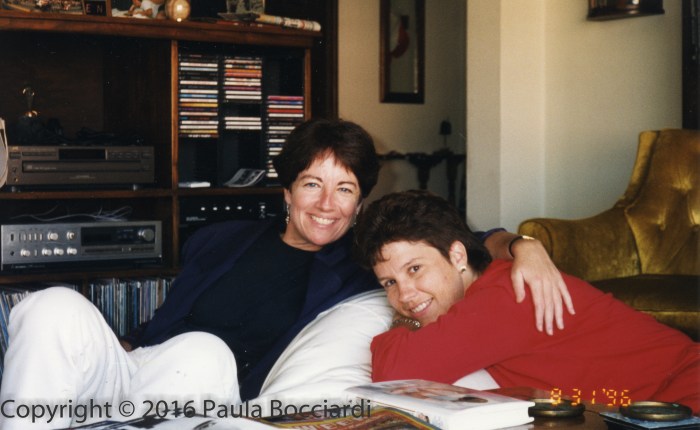
Paula, Julie, and Mom (with copyright)As strange as it is for me to recall now, I was hesitant to tell my mother that I was getting married, even though she loved Julie with every fiber of her being. She was a devoted Catholic, and I was afraid of putting her in an awkward position. But I finally called her, and it turns out that she was full of joy and couldn’t wait to be a part of the festivities. She later told me that she “talked” about it with God for a few days and that after those conversations, she felt that He kept asking her, “Why not, Beverly? Why not?”

***

I know that I have a handful of dear friends and family members, including some of my blog readers, who have heartfelt religious convictions preventing them from supporting gay marriage. (Oh, yes, I know who you are!) I’m deeply happy that you continue to share your friendship with me anyway. And I firmly believe that some of you, at some point, will come to ask yourselves, “Why not?”

***

I have read the entire Bible, cover to cover, word for word – including the “begats.” When I finished the last page, I was thoroughly intoxicated with the rhythm and beauty of the writing and the power of the message. The Bible never gave me doubts. It is the interpreters who have bred the doubt.

I take comfort in knowing with absolute certainty that no one could ever condemn my sweet Julie to eternal damnation. But what about me? What if I am a different story? I’m a religious person, I still say prayers every night, and to be 100 percent honest, I occasionally worry and obsess over whether I will end up rotting in hell with Joni Mitchell and all that couscous.

***

I met Julie Scearce 22 years ago – where else but on a softball field. Duh! It’s how we all meet! She was visiting from Kentucky and filling a temporary vacant spot on our team during a tournament in Tahoe. That girl could throw a baserunner out from far right field. Dreamy.

Julie denies it to this day, but she was actually repulsed by me when we first met. Lucky for me, I eventually won her over with my endless charm, and she moved out west and into my house 20 years ago. She left her family, her friends, her job, and her home to be with me. I think she knew it would kill me to leave my beloved San Francisco, so she made the sacrifice. Those who know Julie would not find that surprising. The woman never thinks about herself.

***

People say that marriage is hard work, but in my case it’s been very easy. I can remember only two major arguments between Julie and me. One happened when she didn’t like a piece of furniture that I had suggested buying, and in the middle of the Ikea aisle I loudly accused her of not loving me. (I believe some hormone issues may have come into play when I pulled that one.)

Our second major argument was on June 13, 2012. It was about baseball. I don’t want to point fingers, so let’s just say this: We were both watching the Giants on television. One of us fell asleep in the middle of the game. Matt Cain went on to pitch the first perfect game in Giants history. The awake one did not want to rouse the asleep one. The next morning, the asleep one found out what she had missed and went bananas. Absolutely bananas. I won’t say who was who, but the argument raged for days.

***

Without Julie, I would never be able to follow the plot of a movie. I just never know what is going on. Thank goodness we now have DVDs and streaming videos and I can pause every five minutes to ask Julie what the heck just happened. Why are they whispering? Is he a bad guy or a good guy? Is that Brian Dennehy or Charles Durning? Is the dark-haired guy Luke Wilson, or one of those innumerable Arquette siblings? What does “money laundering” mean? Why is that guy hiding in the shrubs? Is there a conspiracy I don’t know about? For crying out loud, what’s the connection????!!

(I think I have a hard time telling people apart. Back in the 1990s, when a lot of my friends followed Stanford women’s basketball, I went to one game and realized that I couldn’t distinguish one player from another. I just collectively called them “The Blond Ponytails.” They all looked alike. And to make matters worse, their names were all some version of “Kate”: Kate Starbird, Katy Steding . . . . Oh, and then for God’s sake, there was also Kate Paye!!! I mean, COME ON!!!)

***

Without Julie, there would be no smoky smell of southern barbecue floating into my kitchen window on weekend nights. She lovingly tends to her marinated meats and veggies out on our center patio while I wait inside, drinking my glass of wine like the Queen of Sheba.

Without Julie, I would not understand what baseball’s “double switch” is. She patiently explains it to me over and over, every season.

Without Julie there would be no one in the house to install light switches, set up wireless networks, pound mollies into lathe-and-plaster walls.

Without Julie, I would not know the burnt-oak taste of a good bourbon.

Without Julie, no one in my house would joyfully drive over the speed limit.

Without Julie, no one would do “the Tom Jones dance” down our hallway.

Without Julie, I would not have the unqualified love of my second family in Louisville, and I would not know the natural beauty of Kentucky’s forests and lush green hills, the exhilarating crash of a cleansing thunderstorm, or the flash of fireflies on warm summer nights.

Without Julie, I would not know how to pronounce “Lou-ah-vul.”

Without Julie, there would be no humor in my home.

Without Julie, I might still be encased in Plexiglas.

Without Julie I would be a roiling cauldron of anxiety.

***

I have dragged Julie with me to many of the 15 Springsteen shows I’ve seen. This last time, in March, she had been up nearly 72 hours straight working on a critical project for her employer. Her exhaustion was almost beyond measure. And we had tickets for a Springsteen show in Oakland. I asked her repeatedly whether she should just stay home, but she said that she knew it meant a lot to me and that she would insist on attending. I have no idea how she stayed awake for those four hours and the BART ride home. And it turns out that the next day she came down with viral meningitis, a serious illness that would sideline her for a month. The doctor said it happened because the virus opportunistically raided her exhausted body. She should have been home sleeping that night. But she went out of love for me.

When it comes to our relationship, Julie definitely ended up with the short end of the stick. I can be moody, nervous, impractical, distant, hypersensitive, and juvenile. She, on the other hand, is steadfastly perfect. Always kind, always empathic, always mature. She is good-natured, even-keeled, strong, capable, and selfless. She encourages my passions for drums and train travel. She likes my blog. She calms my nerves. She steadies me.

Happy anniversary, Sweetie. I love you with all the madness in my soul.