A thank-you lives forever

A thank-you lives forever

My father hand-picked my high school teachers. That’s right. He was the principal, so he had special powers, and this was one of them. I didn’t have a particular opinion about it at first, but I grew to realize that although he generally chose the toughest, strictest instructors, he knew exactly what he was doing. Most of my teachers were on the “excellent” end of the scale.

It’s been many decades since I graduated from high school, but since then I’ve thought often about one teacher in particular: Ellen Giannini, who taught Spanish. And I was reminded of her again over the Christmas holidays when I was in Kentucky. It’s become somewhat of a tradition that Julie and I get together every year with my old grade-school classmate Mary and her sister Patty, who now live in Georgetown, KY. Both of them attended my high school, Piedmont Hills (in San Jose). While we were slamming down our hearty diner food, Patty (who graduated a few years before I did) pulled out a few photos of her 50th reunion and I immediately recognized my beloved Mrs. Giannini, who might have aged a little (she’s now nearly 80), but overall she looked much the same as I remembered her.

At that moment, I fell into the vise of yet another Paula Bocciardi obsession: I had to contact her. All these years, I hadn’t even known whether she was alive. Now here she was in the photo, the same woman who’d embodied what I most respect and admire about teachers. And I needed to tell her how much she had meant to me.

With Patty’s help and encouragement, and with some investigative twists and turns, I finally got Mrs. Giannini’s address. Then I sent her a letter in February, telling her what she meant to me and citing examples of her efficacy and her kindness. I told her that she didn’t need to respond, although I was fervently hoping that she would.

But I heard nothing back.

A couple of weeks later, I got this chilling e-mail from the person who’d passed her address on to me:

“At our monthly PHHS luncheon today, I found out that Ellen has had a stroke.”

“Oh, no!” I thought. “She never got my letter.”

***

Ellen Delucchi (her maiden name; she was single then) was the very first teacher I saw when I walked onto the Piedmont Hills grounds in September of 1968. Spanish I was my first class of the day. She was a tiny spitfire with a beehive hairdo, and I liked her immediately because her unwavering no-nonsense demeanor was always accompanied by a persistent twinkle in her eye. The twinkle suggested not only a keen sense of humor but a kind and flexible heart. She was so human, with a rare and perfect combination of toughness and sensitivity.

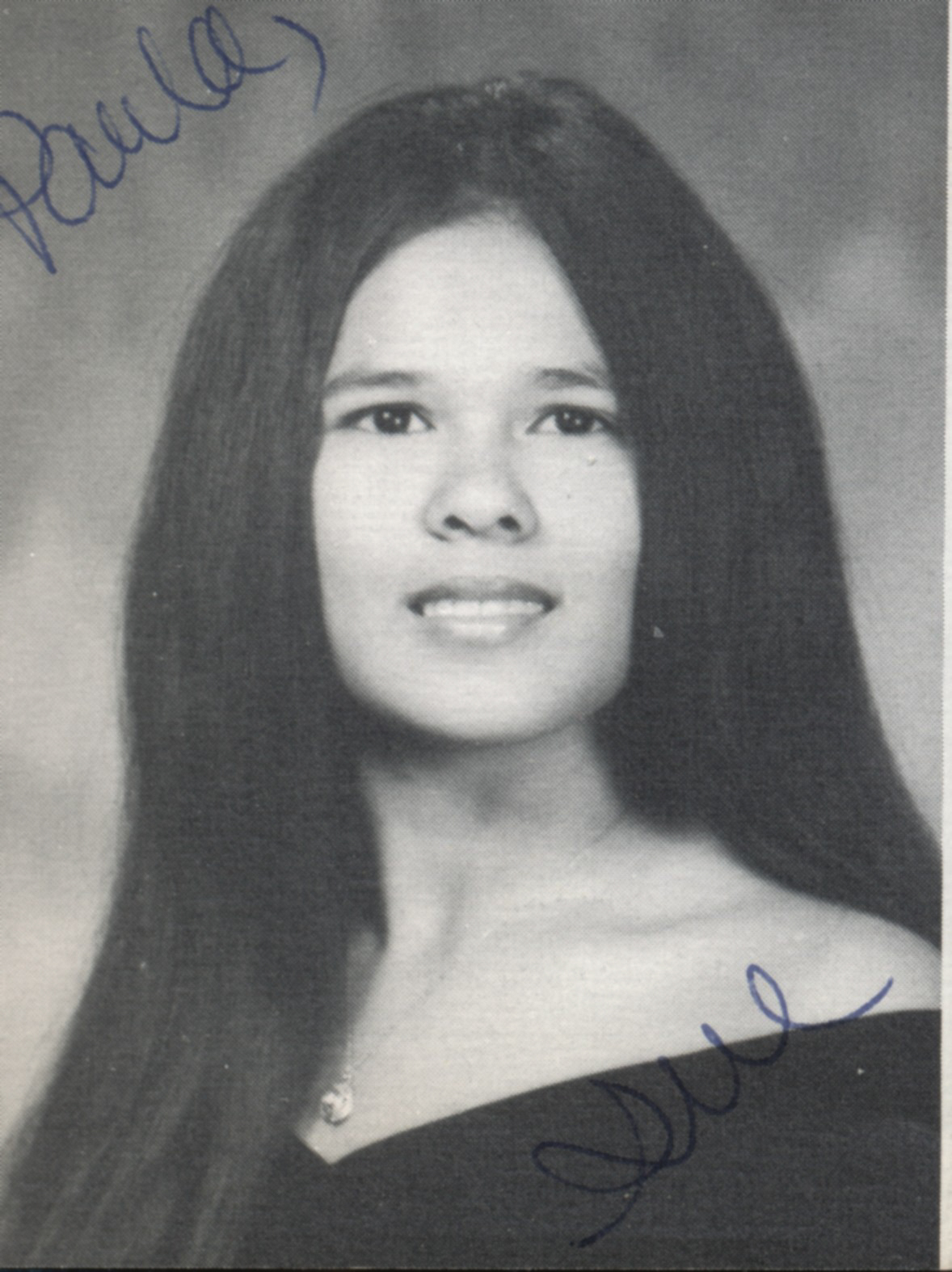
1971_Ellen Delucchi-GianniniIt didn’t take long – perhaps mere minutes – for her empathy to reveal itself in a way I wouldn’t have expected. That first day, the principal of the school – aka “Dad” – stopped by to just “check in on things.” When he strolled to the open doorway of the classroom and leaned oh so casually against the jamb, I was an instant wreck. With a fire-red face I tried to squirm as low into my desk as possible. Dad was probably there less than a minute, but during that time I died a thousand deaths. I was, after all, only 12 years old. And what did Miss Delucchi do? Nothing overt, of course. But then she called the roll. Her routine was to refer to everyone by last name. “Señorita Atkinson?” she would call out. “Señor Azevedo?” Oh, God, I thought, she’s going to say “Señorita Bocciardi” next and they’re all going to turn and stare at me with disdain.

Except she didn’t. “Paula?” she called out, nonchalantly.

You know, even today, as I write this, I get tears in my eyes. She broke her own previously inviolable classroom rule for one reason only: to save me the embarrassment of having the same name as the principal. She couldn’t have been more than 29 years old at the time, but she had the discerning heart of a woman with vast perspective.

Yet she was also a disciplinary stickler to the core. We all knew that she would allow no señor or señorita to stray even one micrometer over the line. And she had the uncanny scofflaw-detecting abilities of a bloodhound. In those days, for instance, the school did not abide gum-chewing by any student. It was an intolerable crime (probably in no small part thanks to Dad). Yet on one particular occasion, Carolyn Edmonds – who sat in the very back row – decided to flout the rules. Miss Delucchi was up at the board, with her back turned to the classroom, writing out some conjugation or another. “Señorita Edmonds?” she called out, without turning even one degree towards us. Uh oh. “Spit out that gum!”

We all gasped. How on earth . . . ? Obviously she had sonor capabilities that could detect a gum-chewer a mile away.

Carolyn slunk up to the garbage can and tossed the offending Chiclets.

The same Carolyn, who was mature beyond her years – after all, she wore a bra in grade school! – was of course also the first to spot the ring on Miss Delucchi’s finger one day. “Miss Delucchi, don’t you have something you need to tell us?” she demanded. Miss Delucchi smiled sheepishly but broadly, telling us that yes, she was soon to be married to a certain Mr. Peter Giannini. We were all delighted for her.

***

Five decades later, I still remember much of the three years of Spanish that I took with Mrs. Giannini, because her passion made it all so enthralling. Learning a foreign language truly enriches our world. It also teaches us about elements of grammar that we may not even have known existed. I learned, for example, about the subjunctive mood, which is used in situations expressing doubt, possibility, desire, or circumstances contrary to fact. It’s complicated, and I was annoyed by it initially, but it’s actually quite beautiful. We don’t use it much in English, but it has its place nonetheless (“If only I were there with you”). A former work colleague in the process of getting his master’s in English once told me that his college professor believed the subjunctive to be useless and therefore not worth teaching. I almost lost consciousness. And I fantasized about siccing Mrs. Giannini on that guy.

***

A few weeks ago, while I was sitting at the Giants game enjoying a sunny day at the park, my cell phone started ringing. Of course, I would never answer the phone at a ballgame, but I did glance at the caller I.D., which merely said “Unknown.” Another robocall, I thought, no doubt about my being an IRS outlaw on the brink of arrest. But the caller left a message (odd!), and my curiosity got to me, so I immediately checked the transcription (this is a much abbreviated version):

“Hi, Paula, this is Ellen Giannini. You probably thought I fell off the face of the earth! What happened was I had a cerebral hemorrhage and I was at the hospital for four days. I go to the ‘Y’ every day to work out, though, and that really saved my goose! But anyway, I wanted to get back to you with regard to that beautiful letter you sent me. You actually took my breath away when I read it. I just couldn’t believe it.”

***

“Oh, my gosh, I thought maybe my letter had killed you!” I joked to Mrs. Giannini when we connected on the phone later that day. “Call me Ellen,” she insisted, although it was hard for me. Lucky for all of us, Ellen’s stroke had left absolutely no residual effects. When I heard her voice, I could tell that she was exactly the same person who’d made such a mark on me 50 years ago. Funny, loquacious, spirited, kind.

“All three of you Bocciardi kids were different,” she said. “You hit the nail right on the head when you said that I didn’t use your last name for a reason. I knew how sensitive you were, and I could tell you were shrinking in embarrassment when your dad showed up. But your sister was the real character. When your dad would come on over the loudspeaker with an announcement, she’d just yell out, ‘Now what do you want?!’ ”

We both cracked up.

I asked her about how times have changed, especially in regard to students with attitude who think there’s no need to listen to their elders. “It’s actually the parents who have changed,” she told me. “A lot of them are now telling teachers what to do. You never saw that back when I started in my career. As for any problem kids, my philosophy was always this: First, talk directly to the student. Don’t immediately resort to taking action by sending the kid to the administrative office. If that doesn’t work, phone the parents. Then, only if all else fails, write a disciplinary referral. The bottom line is that I never took any guff. ‘If you don’t want to stay in this class,’ I’d tell them, ‘go see a counselor and transfer out.’ ”

Before we got off the phone, Mrs. Giannini told me that a group of retired teachers from my school got together regularly, and she thought it would be nice if I could come to her house, chat with her awhile, and then go to the luncheon. It would be held at Harry’s Hofbrau – a deli from my childhood that was a personal favorite because of its enormous portions of freshly carved meat heaped on huge sourdough sandwich rolls. I agreed immediately.

2018_05-29_Harry's Hofbrau_Ellen Giannini, Paula 1I suppose the lunch was a bit anticlimactic. I have to admit that many of the teachers who were there from my era hardly remembered me. All of them, though, seemed to recall my character of a sister!

The overriding sentiment I sensed at that lunch was that these people were genuinely happy. They had a camaraderie that reflected not only their shared experiences but also their shared commitment to education. I would think – or at least hope – that they’re content with, and proud of, their careers in public service.

Teachers have to deal with a lot. They’re instructors, parents, psychologists, and disciplinarians. They have to deal with demanding and critical parents. They work long days, spending many an evening at home correcting papers and preparing lesson plans. In inflation-adjusted terms, teacher pay has fallen nationally over the past decade, yet 94 percent of teachers, according to the stats I’ve read, spend their own money to buy school supplies. And in this country, at least, they now have the added worry about feeling secure in their classrooms. But their dedication persists. They deserve our deepest respect and our greatest gratitude.

***

All of us can look back and appreciate the scores of people who, along the way, have made a positive impact on our lives. And it could have been just a gesture, a word, the slightest whisper of an influence that blew us gently in one direction or another.

Maybe somebody suggested you have an artistic talent you were unsure about. Maybe they said a kind word when you nervously told them a secret. Maybe they held you while you cried. Maybe someone hired you just when you were getting desperate. Maybe someone called just when you thought you were going to fly apart over a broken heart. Maybe they gave you a book to read that steered you away from self-destruction. Maybe they told you that you were beautiful, in one way or another.

I suggest thanking them. Write them a letter, call them, send them a text – just let them know. Show appreciation for someone who is least expecting it. Don’t let a life end before you show your gratitude. It will make both of you happy. A thank-you will live forever in both of your hearts.

Before I left her house, Mrs. Giannini mentioned to me that she had re-read my letter many times. I had a twinkle in my eye all the way home.

the end

***

Due to popular demand, I am including, at the end of each blog post, the latest random diary entries that I’ve been posting on Facebook for “Throwback Thursday.” These are all taken absolutely verbatim from the lengthy diaries I kept between 1970 and 1987.

1/11/71:

“I have made up my mind a long time ago not to ever smoke weed. But now that I’ve listened to the other side I’m not so sure. I mean, I’m not really going to, I don’t think. But it doesn’t sound that bad. I’m getting [the info] straight from someone who does it and really knows. Oh, shoooooooooot!!!”


12/26/70:

“Today and Sunday were average days. We got up around 9:30. After breakfast we watched football. The SAN FRANCISCO 49ers are division champions! And today they beat Minnesota and I hope they go all the way to the SUPER BOWL. I practiced shooting with Grampy’s pellet gun and can now do 13 jumps on the pogo stick. I got blisters on my hand from the pogo stick. In the afternoon we went over to the cousins [house] and looked at dirty books until [my sister] Janine squealed and we got in trouble.”

12/11/70:

“You know, for some strange, wierd [sic], unexplainable, mystical reason I began to think about Nonna’s [my grandparents’ house]. It began Sunday when I saw some old pictures. Now, I feel, I don’t know, crushed, it feels hard to breathe. I know I will never again see those days. I remember we used to watch Shirley Temple. I remember the chicken store, Nonno’s love, fresh fugaccia [dialect for focaccia], the old house, the garage with the scales, the “treasures” we used to find in the chairs, the old ball park, the zucchini and the flowers, how we used to play on the porch, soccer on the cracked patio, naps in the cold bedroom, the pantry, the basement with the old games, and bottles, and the dirt where I thought money was buried. I can’t get over that ache in my heart.”

Lovely to see you again, my friends

Lovely to see you again, my friends

TO THE CLASS OF 2017:

It was 45 years ago this month that I graduated from high school, and every so often a few of my old friends get together for a weekend of wine, memories, laughs, and sentiment. This time we met up in Ventura. Even though our school – Piedmont Hills – was located on the east side of San Jose, a handful of us have relocated to southern California, and we thought we’d gather down there for a change.

Two days, many cocktails, countless stories, a plethora of hugs, and a few tears later, I drove back home, cranking up the tunes (a luxury best reserved for solo driving) and reflecting on where we’d all come from and where all these years had taken us.

***

I was utterly terrified on my first day of high school. I’d come from a Catholic school and had never known what it was like to have lockers, carry books, change classes, navigate from building to building, or walk hallways filled with students who were older, more mature, and almost adults. “I couldn’t believe that I was now surrounded by men,” one of us said this weekend. “Not boys, but men. With beards.” To some of us that was exhilarating. To me, it was just plain frightening. Raised by loving but extremely protective parents, I was naïve and unsophisticated.

Within minutes after I arrived at school that first day, a senior boy/man saw me and took off his class ring, slipping it on my finger and asking me how that felt. I didn’t know what to make of the entire thing. I was only 12 years old. Just a baby. I went home and told my father about the whole mystifying situation, and he made quick work of tracking down that senior and handing him a stern lecture. My father, you see, was the principal.

Obviously I had a few strikes against me.

Barb-2
Barb

Later that day, we were all asked to pair up and choose locker partners. Most of my St. Victor’s Elementary School classmates were off at Catholic high schools, and I didn’t know a soul. The time ticked down and I found myself standing alone, consumed, as always, with worry. But I mustered my courage, walked up to a total stranger, and asked her to be my partner. Her name was Barbara. I don’t know why I picked her. Maybe it was because she looked reserved, she wasn’t rocking a miniskirt, and she wasn’t sporting two tons of blue eye shadow. I hoped that my intuition was right and that she wouldn’t reject me. Saints be praised, she said yes immediately, which was a great act of gallantry because she had to have known that I was the principal’s daughter and that her association with me could prove to be an inconvenience at best. Almost half a century later, we’re still in touch. And by the way, she still looks exactly the same.

Barb didn’t have a single affectation. There wasn’t an elitist or supercilious bone in her body. Her parents worked on a farm, and she routinely presented me with gorgeous fresh produce as gifts. One time she gave me some sweet anise on my birthday and I was so thrilled that I gushed about it in my diary. I also remember driving out to the farm with my parents to pick squash blossoms, because there is nothing more delicious in this world than fried zucchini flowers. (Just dip them in egg and flour, fry briefly in oil, and be prepared to swoon.)

In those days, San Jose was not the technology mecca it is today. Much of it, in fact – especially on the east side, where we lived – was agricultural land. As my high school years went on, I would befriend lots of kids who had grown up on ranches and farms and knew their way around the county fair.

***

Barb had met Sue when they started kindergarten at Orchard Elementary School, one of the oldest educational institutions in the state (1856) and one that served residents of a part of the city that remained agrarian despite the burgeoning presence of housing tracts and malls. The two girls bonded at naptime that first day because Sue had an apparently-coveted Huckleberry Hound mat.

Sue-2
Sue

While Barb was more reticent, Sue was outgoing and full of spirit. She was optimistic and quick to laugh. I also thought she was very grown up – not in a “blue eye shadow” kind of way, but in a wise kind of way. She meant a lot to me because she always gave me good advice that came from a warm place deep in her heart.

In preparation for this reunion, I decided to drag out my diaries. For about 17 years, I diligently wrote in those little books every night, with the tiniest of Parker pen nibs. The diaries were delightfully unfiltered and un-self-censored, and when I think about it, I really have in my hands a remarkably honest chronicle of a young girl’s adolescence and young adulthood.

According to my diary, in March of 1972 I decided to run away from home. I loved my parents dearly, but holy cats they were strict with me! I wasn’t allowed to wear pants to school when girls were finally given that “privilege.” I wasn’t allowed to spend the night at a friend’s house ever, even if both sets of parents knew and thought highly of each other, because my father thought it was barbaric not to be at home at night. On my first date (I was a senior) with Jerry Miyakusu, my curfew was so early that Jerry had to shatter speed records racing home from Shakey’s Pizza Parlor in his sports car on dangerously curvy backroads. I’ve never wolfed down a pizza that fast since. And I think Jerry created a sonic boom as he hurtled me home. He wouldn’t have had time to kiss me even if he had wanted to.

(By the way, in 1972 when I was finally allowed to wear pants to school – but only on Fridays – I donned a super-cool ensemble that consisted of tight gold-plaid pants and long-sleeved gold Western blouses with lots of embroidered curlicues and snaps.)

Anyway, my frustrations with my folks had been piling up, and according to my diary, on March 21:

I called Sue because I thought she had an empty duplex, but it’s inhabited. She said, “Don’t leave, Paula, it won’t solve anything.” So I didn’t.

It was as simple as that. My plans were instantly jettisoned. Sue had spoken.

I guess it makes sense that Sue would go on to be a teacher and a motivational speaker.

***

I was an absent-minded little thing. It was legendary. My mother would ask me to “watch the rolls,” and I stood and stared at the oven glass and watched the rolls burn to a crisp. I routinely threw my socks away. I was playing the board game Risk once, with a Ritz cracker in my hand, and I popped the dice into my mouth and rolled the cracker!

Wednesday I looked in my purse for my glasses but they weren’t there. Obviously I almost had a heart attack! I decided to tell the parents at Clear Lake this weekend when they were in a good mood. But luckily I asked Miss Lasagna [yes, that was her real name] and she said she found them and my badminton racket on her desk. Whew! I don’t know how many times I have come so close to losing my glasses. And last Thursday I came home from badminton, changed, took off my blouse, and calmly went into the bathroom and deposited it in the toilet!

When I read back over those diaries, I am absolutely astounded at how worried I was about every little thing. I mean, I was a roiling cauldron of anxiety.

Boy, am I worried. Last semester I had a lot of points wrapped up by Final time, but not this year. In Chem I have a 90%, and I need an 86 on the Final to get an A. Shoot! His Finals are tough. I may shoot myself if I miss it. You won’t believe how worried I am. Every so often little pangs of fear go through me.

I am worried sick about the swim test tomorrow because of only one thing – diving. I can do everything else but that, and I get so embarrassed when I bellyflop.

Friday is the GAA/Faculty Mixed Doubles Tennis Tournament, and I am worried. I have to play some of the best players. It’ll be worse with Mr. Barisich as my partner because now he’ll know how really lousy I am.

Nearly every page is filled with one anxiety or another, sometimes accompanied by beseeching prayers to the Almighty. This one really takes the cake:

I, my friends, am really up-tight about something which most people would be happy about. “Our gang,” or, as we have come to call ourselves, “the out crowd,” has informed me that I may accidentally get a lot of nominations for Junior Prom Princess. Well, for one thing, I am not pretty. The only time I may be cute is when I smile, which helps decrease the length of my nose. Maybe I can persuade the kids to put up somebody else. Help me, God!

Finally, there’s this:

Today I went to the dentist. I had no cavities but I had fluoride. YICK! I hate it, and it always upsets me for a long time.

I honestly can’t figure out what on earth that last one means.

***

It was an interesting time to be young, back then. Just a few months before we started as freshmen, both Martin Luther King and Bobby Kennedy had been assassinated. The number of Vietnam War casualties would hit an all-time high of nearly 17,000 in 1968. New and wilder kinds of drugs were infiltrating the schools.

Over the next four years, the war engagement would start to wind down. Men’s hair would grow longer. Women would start to speak up. The voting age would be reduced from 21 to 18. Meanwhile, we were learning who we were and how we fit in with the changing times. Some of us (myself not included) wore black armbands to school to protest the war. Some of us struggled with figuring out our political identities and how to behave in a world in which gender roles were suddenly changing. We made mistakes and we were insecure and we were sometimes jealous in the most petty of ways, but we were all finding our way, bound together by the fears and joys and struggles of adolescence.

I remained – not altogether voluntarily – essentially a Puritan. My friends still remember the long skirts my mother sewed for me. And of course, as the principal’s daughter, I could get away with nothing. On Senior Cut Day I was one of the few hapless kids forced to come to school. The worst thing I ever did was steal some pre-signed get-out-of-class-free pink slips from one of the counselors and use them liberally during my senior year. I was finally caught by a sympathetic teacher who never ratted me out to my father, thank goodness.

Jane-2
Jane

Some of the friends I hung out with, though, were a little wilder. I loved them for what they were, but I think they deliberately withheld a lot of their activities from me – an arrangement that, in truth, was beneficial to all parties concerned. One of those friends was Jane, who had a gorgeous English accent and whom I always considered to be supremely exotic. She seemed so worldly. She flowed mysteriously through our group and I was never quite sure what she was up to, believing that one day she’d end up as some kind of insurgent – maybe one of those radicals who joined the Weather Underground and set off explosives.

Uh, no.

Jane became a nurse. A Critical Care nurse, in fact. I imagine she has helped save thousands of lives in her career. In Ventura we talked about what retirement would mean for her, and she said she feared that leaving her job would mean losing her purpose in life. So we all discussed options that would enable her to maintain her dedication to health care, such as volunteering in places like homeless shelters. As she wavered about eventual retirement, I could see, in her eyes, her devotion to her calling.

***

Jane wasn’t the only one of the group who went into public service. I suppose it was the specific time in which we graduated, but it’s interesting that no one in our group left high school with the goal of making money. That wasn’t even in our vernacular. I think it was because we graduated at the tail end of the peace-and-love days. We were many years removed from the Summer of Love, but we were also two years ahead of the invention of the microprocessor and the total domination of the world by Silicon Valley. Just a couple of years after we left high school, people’s values began to change. But we just wanted to study the arts and help people and have a lot of goofy fun along the way.

Terrie-2
Terrie

Our friend Terrie became a lifelong public servant, too. After high school I lost track of her until many years later when I was reading the San Francisco Chronicle and her name suddenly appeared. I don’t remember what the story was about, but I learned that Terrie was a police officer in Morgan Hill. Eventually she would become Commander. Remember that in the 1970s there were very few female police officers anywhere, and Terrie was the only woman on the Morgan Hill force for a long time. To this day she says she didn’t think about it much. If she faced any biases, she never let them get under her skin. And she truly loved her job. In Ventura she talked about how people she’d arrested had come back to thank her because she listened so openly to them and, if they were willing, she helped them find their way towards becoming productive members of society. “It’s how you handle yourself,” she once said. “That goes across the board. If you have the ability to talk to people, to respect them, you can accomplish a lot. You always aim for diffusing a situation, not using force.” Terrie is probably one of the most compassionate people I’ve ever met, and when she retired after serving for 26 years, the whole community felt the loss. A 2006 Letter to the Editor in the Morgan Hill Times said, “We have never met a more kind, generous, hard-working and professional public servant in our lives. Morgan Hill has been blessed. The force will be without her, but we know that she will only redirect her many talents in other community aspects. The quality of our community is so much better because of Terrie. May the force continue to be with you Terrie.”

***

Mary-2
Mary

Our friend Mary is the one who keeps everyone laughing, and she increases the hilarity quotient of any gathering by 1,000 percent.  I mean, spend 5 minutes with the woman and you need to take Advil to soothe your stretched-out-from-laughing jaw muscles. I love her stories of our high school days, like the time she found an entire unopened jug of Spañada wine in the orchard and considered it to be the greatest treasure find of her young life. From what I gather, she dipped into that thing any number of times during the school year. My favorite family anecdote of hers is that she “started a campaign around Christmas time one year to convince my two younger sisters that Santa was indeed watching them – even in the bathroom. I constructed little paper cameras and colored them black, then placed them on top of the light so they could just see enough to be nervous!”

Mary left her home in northern California a number of years ago so that she could care for her mother, who had Alzheimer’s disease. She gave up a lot, but that’s who she is, and she wouldn’t have dreamed of doing things differently. She’s currently thinking about starting a humor blog, and we couldn’t be more encouraging about that. Start it now, Mary. It’s never too late.

***

When I really think about it, there weren’t all that many things that our group had in common. But we didn’t judge each other. We weren’t snarky. We were never arrogant. We never thought that we were the most interesting creatures on the planet.

Hmmm. Maybe that’s what we had in common.

Half of us turned out to be gay, proving, beyond a shadow of a doubt, my longtime contention that something sketchy was going on with the drinking water in the East San Jose foothills. Half of us ended up caring for parents with Alzheimer’s. Half of us had kids and grandchildren. And all of us have been successful. It really rankles me that the term “successful” means, to many people, earning a lot of money. You never hear people say that someone is “a successful preschool teacher” or “a successful police officer” or “a successful court clerk.” Well, in my book we’re successful if we pay our taxes and behave like responsible citizens. We’re successful if we raise our children with all the selflessness that that role demands. We’re successful if we keep our commitments to friends and family. Really, we’re successful if we manage to navigate our way gracefully through life’s challenges.

Being with these old classmates, despite the years and the miles, was easy. We don’t have to get to know each other all over again. It’s like the comfort of being bandmates or teammates or lovers. You may move on, but you can’t dismiss the times you spent together and the influences you had on each other’s lives.

As Sue summed it up later, “I just can’t put into words how precious every moment, every laugh, every tear is to my heart.”

***

A few days after I returned from Ventura, my family got together in San Jose to bestow our Gerald and Beverly Bocciardi scholarships on four remarkable seniors. All of them have specific goals and majors in mind, but the truth is, some of them will end up in places, and enjoying accomplishments, that they cannot even imagine now. We shook their hands and asked them about their college choices and their chosen fields, but if I’d had the time I would have said a lot more than that.

Don’t short-change yourself. Every so often, say hello to someone you don’t know. Be grateful for fresh produce. If someone you love wants to run away from home, or from life, talk them through it. Make others laugh. Consider public service. If you venture into the business world, keep your integrity; they’ll take your soul if you let them, ah, but don’t you let them. Take care of your parents, and learn about their lives; they are far more interesting than you think. Most importantly, hang on to your friends with character – the ones who count. If they call out your name, come running.

And for God’s sake, don’t be upset by fluoride.

Write your own life’s music. Learn the chords and the rudiments from the people who came before you, but then make the score your own. Play it loudly and then eventually teach it to others. That’s the reason you’re here.

That’s what we were doing, back in 1968. We were just trying to figure out our songs.

1972_06_Paula