
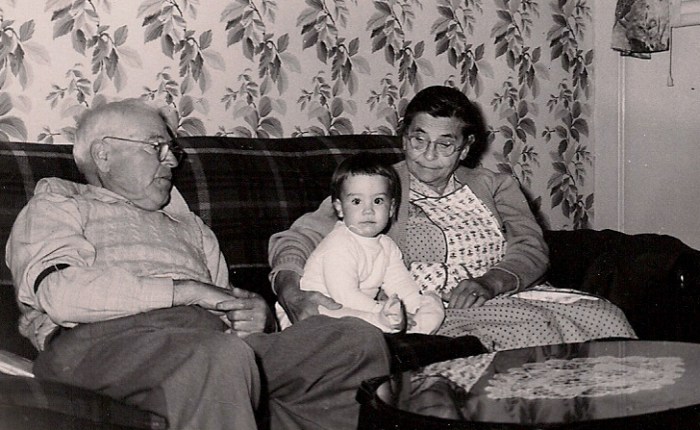
Well before dawn this coming Wednesday, city officials and a parade of fire trucks will convene downtown for the annual commemoration, at Lotta’s Fountain, of the 1906 San Francisco earthquake and fire, which killed up to 3,000 people, destroyed 28,000 buildings, and rendered 225,000 people homeless. Lotta’s Fountain was a gift to the City from Lotta Crabtree, a local actress, and it was used as a meeting place for residents after the quake. The last two survivors of the devastation died a couple of years ago, but the annual ceremony continues, beginning at 4:30 a.m. and counting down to a moment of silence at 5:12 a.m., which is the moment the earthquake struck.
My grandmother, 18-year-old Ambrogia Fontana, was one of the survivors. Newly arrived from Italy through Ellis Island, she had been in San Francisco less than a week. She spoke no English. She and her younger brother David were aiming to get a foothold in the new land, trying to figure out the people, the food, the language, the urban hustle. The culture shock was immeasurable. The two of them were asleep on Wednesday morning, April 18, 1906, when the most devastating natural trauma ever to hit San Francisco shook and burned the city. David was smashed in the head by a falling ceiling beam and was injured so badly that he was knocked unconscious and lapsed into a coma. The two of them were carted off to a tent city for quake refugees. Ambrogia had no idea where she was, where to go, or what to do, and no one could understand her. All around her, the city was in ruins.
***
Ambrogia, who was born in 1887, had grown up cutting quite a rebellious figure in the tiny northern Italian town of Staffoli, near Lucca in the Tuscan region. The oldest of 8 children, she worked in her father’s bottega (shop) where, at the age of 9, she spent her days making panini (sandwiches) while pouring a bit of grappa for herself every time she served a glass to a customer. Stern, robust, and always resentful of authority, as a teenager she would deliberately walk the streets of Staffoli wearing – gasp! – pants and smoking a Toscano cigar, just because it wasn’t done in those days.
(As an aside, Staffoli was originally in the province of Florence, but when Mussolini tinkered with the divisions in 1920 [gerrymandering!], he made Staffoli part of the province of Pisa. This would enrage my grandmother, who considered all Pisans to be thieves. The sentiment seems to endure somewhat today, and it may have stemmed from a time in history when many Pisans were tax collectors. One of my grandmother’s favorite [albeit skeevy] sayings was “Meglio che mangiare la tigna dalla testa di un cane che avere un Pisano alla porta!” [“Better to eat the mange off the head of a dog than to have a Pisan at the door!”])
Ambrogia’s father Pietro was a fairly successful businessman. In addition to owning the bottega, he was a cattle dealer, buying the animals in Milan or Venice and selling them in Florence. He also traveled extensively to Sao Pao, Brazil, where he had a coffee plantation, and to Buenos Aires, Argentina, where he owned a brewery. Rumor has it that he kept a woman in every port, and the fact that two of his children were named Brasila and America certainly nurtured the speculation.
Although he was one of Staffoli’s few wealthy residents, Pietro was, for some reason, a socialist. In fact, he periodically hosted neighborhood socialist meetings with about 15 other men – a risky proposition, given that at that time the Italian government was cracking down hard on political activists, especially anarchists and socialists. The women, of course, were not allowed to participate in the meetings. Ambrogia was required to serve the males, and she grew increasingly resentful of her father’s rigorous authoritarianism. (Little did he know that when he went off on his trips, she would gather up her younger siblings, haul a bounty of salame, bread, and a bottle of chianti up to their room, and host a food-and-wine fest on their beds!)
At one particular political meeting, at which the now-18-year-old Ambrogia was, as usual, serving, Pietro’s rigid child-rearing practices were questioned by one of his more lenient buddies. “My children,” he responded angrily, “can do whatever they want in life.” This was the moment my quick-witted grandmother seized like a snake. “Oh, yeah?” she piped up in front of everyone. “Then I want to go to America.” Shocked by her audacity, the rest of the men challenged him. “You heard her, Pietro. So you will really send your daughter to America, then,” they said, mockingly. Pietro was stuck. He had made a proclamation and he couldn’t backtrack. His ego overruled his common sense. “Sure,” he answered. His wife immediately began to cry. But it was done.
That’s how my grandmother came to find herself boarding the steamship Prinzess Irene in Genoa, Italy, on March 22, 1906. It was unheard-of in those days for a young woman to travel alone; typically, in fact, it was a household’s father or eldest son who made the voyage and then sent for the rest of the family when life was settled. In this case, though, Ambrogia’s dim-witted 16-year-old brother Davide (David) was sent with her as a “chaperone.”
![PrinzessIrene2-[edited for blog]](https://mondaymorningrail.com/wp-content/uploads/2018/04/prinzessirene2-edited-for-blog.jpg)
The Prinzess Irene was a German-built ocean liner that ran on the Genoa-to-New York line beginning in 1903. She was 540 feet long and 60 feet wide, weighed almost 11,000 tons, and traveled at about 15 knots (18 mph). The ship carried more than 2,000 passengers – most of them, including my grandmother, in 3rd class or “steerage.”
Before boarding, passengers were asked to answer a number of questions, the oddest of which included whether they were polygamists or anarchists. I’m fairly sure my grandmother was not the former, but she may well have been the latter. In any case, both she and David answered “no” appropriately. They also were subject to medical examinations and to “disinfection.”
![generic 1909 passport-[edited for blog]](https://mondaymorningrail.com/wp-content/uploads/2018/04/generic-1909-passport-edited-for-blog.jpg) There is no way to sugarcoat the experience of the passengers in steerage. In fact, up to 10 percent of them died on the way. They sat crowded together, in the dark, under the most unsanitary of conditions. The air was chokingly foul. Five years after my grandmother’s trip, the U.S. Immigrant Service reported that “[t]he open deck space reserved for steerage passengers is usually very limited, and situated in the worst part of the ship, subject to the most violent motion, to the dirt from the stacks and the odors from the hold and galleys. . . . The ventilation is almost always inadequate, and the air soon becomes foul. The unattended vomit of the seasick, the odors of not too clean bodies, the reek of food and the awful stench of the nearby toilet rooms make the atmosphere of the steerage such that it is a marvel that human flesh can endure it . . . . Most immigrants lie in their berths for most of the voyage, in a stupor caused by the foul air. The food often repels them. . . . It is almost impossible to keep personally clean. All of these conditions are naturally aggravated by the crowding.”
There is no way to sugarcoat the experience of the passengers in steerage. In fact, up to 10 percent of them died on the way. They sat crowded together, in the dark, under the most unsanitary of conditions. The air was chokingly foul. Five years after my grandmother’s trip, the U.S. Immigrant Service reported that “[t]he open deck space reserved for steerage passengers is usually very limited, and situated in the worst part of the ship, subject to the most violent motion, to the dirt from the stacks and the odors from the hold and galleys. . . . The ventilation is almost always inadequate, and the air soon becomes foul. The unattended vomit of the seasick, the odors of not too clean bodies, the reek of food and the awful stench of the nearby toilet rooms make the atmosphere of the steerage such that it is a marvel that human flesh can endure it . . . . Most immigrants lie in their berths for most of the voyage, in a stupor caused by the foul air. The food often repels them. . . . It is almost impossible to keep personally clean. All of these conditions are naturally aggravated by the crowding.”
In my grandmother’s case, this went on for 15 days. She and David arrived in New York on April 6. She had $25 in her pocket.
***
Three million Italians came to the United States between 1900 and 1915 during the “New Immigration” of Slavs, Jews, and Italians. Most of them were farm workers and unskilled laborers fleeing not only a politically chaotic country but also the crush of abject poverty. That was not the case with my grandmother, but it did apply to my grandfather.
Gustavo Bocciardi, a Tuscan like my grandmother, grew up extremely poor and with very little education. In April 1904, Gustavo came to America (also on the Prinzess Irene) by himself, as a teenager, in search of work. A couple of aunts in California had wired him the money to find his way out west. While on the train from Ellis Island to San Francisco, he was nearly taken advantage of when the guy at the café counter tried to charge him something like $30 for a 52-cent sandwich. As the story goes, my grandfather – short in stature, but strong as a bull – grabbed the guy by the collar and throttled him until he got his money back.
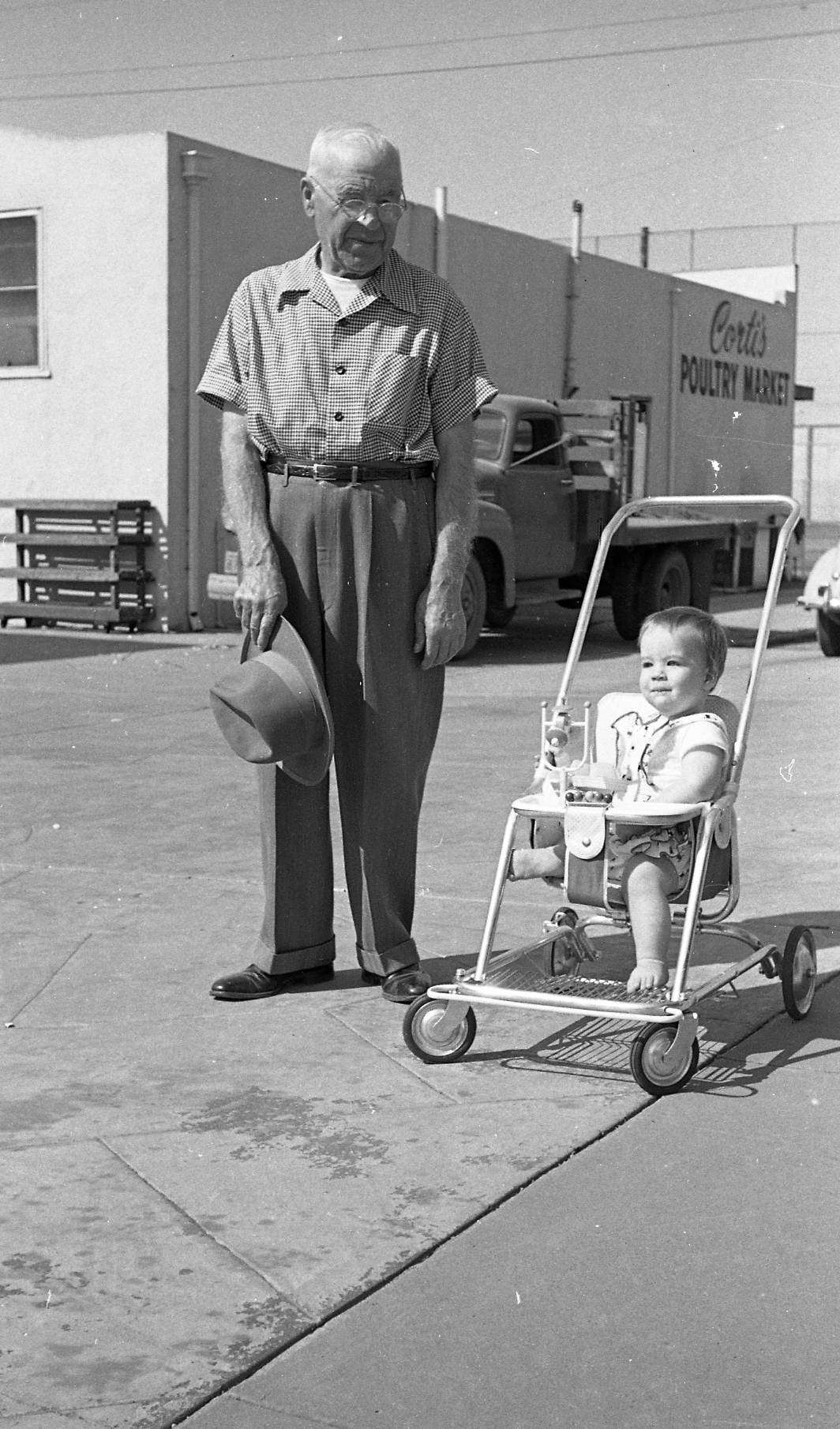
My grandfather was an interesting dichotomy. He was an emotional pushover who, in his later years, liked to push me around the neighborhood in a stroller to show me off. But apparently he had a temper – one I never, ever saw. Maybe his attitude was hardened by the bigotry that Italians regularly endured in this country. My dad told me that one day a passerby called Gustavo a “dago” to his face. “So he dropped the son of a bitch,” my father said, rather dryly. The man hit his head on the sidewalk, and Gustavo thought he’d killed him. While he was trying to explain the situation to his aunts afterwards, a police officer arrived at the door – a fellow who knew the aunts and liked them. “That guy is a jerk,” said the officer. “He’s just fine, he didn’t die, and you just tell your nephew Gustavo not to worry about it.”
***
In the few days between the time they arrived in San Francisco and the time the Great Earthquake hit, Ambrogia and her brother David had been staying in SF with their relatives the Mancinis. On April 18, the Mancinis had already gone to work by 5:12 am. – the moment the house was destroyed, and David was critically hurt – and they had no idea where their young charges were. The American Red Cross and local charities were providing food and medical care to everyone in the tent cities, which is where Ambrogia found herself, along with David, who was unconscious for days. One day, as Ambrogia was still trying to make sense out of what had happened to her, she heard Italian being spoken outside their tent. She ran out and discovered that a representative from the Italian consulate was walking around offering assistance, and she was able to tell him that she had been separated from the Mancinis, who, she knew, had relatives in Redwood City. Somehow the Consulate ended up finding the relatives and providing Ambrogia and David with transportation to their home. David would recover from his injuries.
***
By 1907, after working for a short time as a nanny, Ambrogia packed up and moved to San Leandro, a small city across the Bay from San Francisco to which many people displaced by the quake had relocated. She began working at the King-Morse cannery off of San Leandro Boulevard (now the site of the San Leandro BART station). Meanwhile, Gustavo Bocciardi – who’d been working as a logger in Boulder Creek – had also moved to San Leandro and was working at the same place.
![Del Monte Cannery-[edited for blog]](https://mondaymorningrail.com/wp-content/uploads/2018/04/del-monte-cannery-edited-for-blog.jpg)
Gustavo and Ambrogia saw each other for the first time at that cannery. And here’s the craziest thing: they discovered that they were from the same tiny town in Italy! And they hadn’t known each other! I don’t know the population of Staffoli back then, but even now it has only a few thousand people. I can’t imagine how they could not have run into each other, especially because they were only two years apart in age. But my grandfather was poor and uneducated, and my grandmother traveled in a different universe.
Not surprisingly, Gustavo and Ambrogia ended up getting married, in Oakland, on December 30, 1907. A year later they had their first child, my aunt Nini, whose real name was actually Maria. [Ed’s note: every Italian family has a Maria!] My grandfather apparently won the naming rights and chose to name my aunt after his grandmother Maria, even though my grandmother – who was very anti-clerical (but not anti-religious) at the time – emphatically insisted that the Biblical Maria (Mary) was “the world’s first whore”!
![1916_(L to R)_Giannina Corti, Gino Corti, Rizzieri Matteucci, Gustavo Bocciardi, Marie Bocciardi, Ambrogia Bocciardi-[edited for blog]](https://mondaymorningrail.com/wp-content/uploads/2018/04/1916_l-to-r_giannina-corti-gino-corti-rizzieri-matteucci-gustavo-bocciardi-marie-bocciardi-ambrogia-bocciardi-edited-for-blog.jpg)
What continues to amaze me to this day is that my indefatigable grandmother found an additional way to make money. At night she would cook up an abundance of food that she could feed at lunch the following day to the many single young men who worked alongside her at the cannery: stews, chicken in sauce, etc. In the morning she would set the table, and at noon she’d race home to heat up the food. Then the cannery workers would come over and buy lunch from her to eat while they rested! How she did all this and cared for a baby, I do not know. She was strong, smart, and determined. It didn’t matter that she had been brought up in a family of means. She was on her own now, and she had no expectations of being handed anything anymore. She could stand on her own two feet. And hold everybody else up as well.
***
![San Leandro ballpark sign-[edited for blog]](https://mondaymorningrail.com/wp-content/uploads/2018/04/san-leandro-ballpark-sign-edited-for-blog.jpg) At some point my grandmother quit the Cannery and they rented a house in San Leandro. Gustavo then worked at a variety of jobs – lumberyard, sawmill, munitions factory during World War I, etc. – for a few years each until his hot temper got him kicked out. Finally, nearly 20 years later, they could afford to have their first home built in 1926, right across the street from the San Leandro Ballpark (adjacent to the cannery) where my father says he saw Billy Martin play before he made it into the majors. Tickets to the Sunday afternoon baseball games cost 15 cents for gentlemen and 10 cents for ladies. What a steal! (That field, which I remember well, is now long gone, demolished when the BART station was built.)
At some point my grandmother quit the Cannery and they rented a house in San Leandro. Gustavo then worked at a variety of jobs – lumberyard, sawmill, munitions factory during World War I, etc. – for a few years each until his hot temper got him kicked out. Finally, nearly 20 years later, they could afford to have their first home built in 1926, right across the street from the San Leandro Ballpark (adjacent to the cannery) where my father says he saw Billy Martin play before he made it into the majors. Tickets to the Sunday afternoon baseball games cost 15 cents for gentlemen and 10 cents for ladies. What a steal! (That field, which I remember well, is now long gone, demolished when the BART station was built.)
By then my grandfather had gotten into the poultry business, and eventually he established his own market with two other guys – one of whom was his new son-in-law Ray. My grandparents weren’t keen on Ray because he was, irony of ironies, a Pisan! And true to stereotype, Ray’s father was a crook – a bootlegger who somehow cheated my grandfather out of a lot of money, although no one quite remembers how.
![1925_San Leandro_Gustavo Bocciardi in Dodge truck-[edited for blog]](https://mondaymorningrail.com/wp-content/uploads/2018/04/1925_san-leandro_gustavo-bocciardi-in-dodge-truck-edited-for-blog.jpg)
Nearly nineteen years after Maria was born (yes, you read that right), along came my father in 1927. He was almost named “Sbaglio” (“Mistake”) because my grandparents had been convinced that they were too old to have children. In fact, once she started to show, my grandmother went to the local pharmacist to ask him what to do for her “tumor.” His reply? “That’s no tumor, lady. That’s a baby!”
Dad once said that they should have named him “Tumor.”
![1937_12_Dad, Gustavo and Ambrogia Bocciardi-[edited for blog]](https://mondaymorningrail.com/wp-content/uploads/2018/04/1937_12_dad-gustavo-and-ambrogia-bocciardi-edited-for-blog.jpg)
***
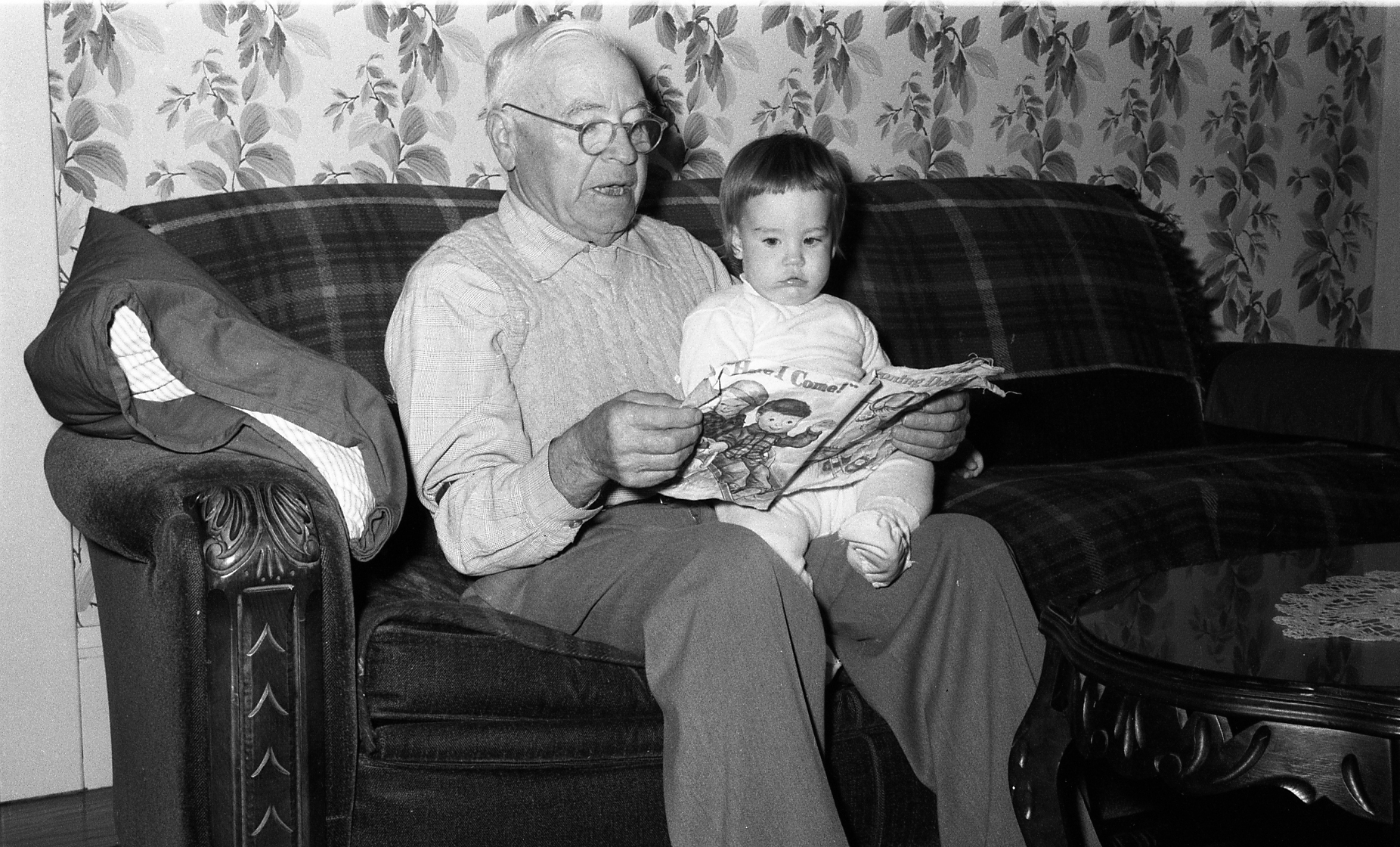
I’m only half Italian, but nearly all of my historical and cultural understanding of my heritage came from that side of the family. The German relatives on my mother’s side were almost guarded about their ancestry. But the Italians were proud and joyful.
My first language was actually Italian. I didn’t know how to speak English until I was about three years old and my maternal grandmother was babysitting me one day, couldn’t understand my repeated requests for acqua (water), and implored my parents to for God’s sake teach me some English.
![1956_07_Mom, Paula, Ambrogia Bocciardi(b)-[edited for blog]](https://mondaymorningrail.com/wp-content/uploads/2018/04/1956_07_mom-paula-ambrogia-bocciardib-edited-for-blog.jpg)

***
What great resilience and fortitude the immigrants had. How did those people from quiet little towns – some of them teenagers, like my relatives – find the courage to leave their homes and families and travel in horrid conditions across an ocean without knowing whether they would even survive the journey or, if they did, what they would do when they arrived? Most of the time they would end up sacrificing everything for their own new families in America. And yet, despite the prejudice and the barriers, they did it without complaint. Without defeat. They were heroes without monuments.
One of my very favorite movies, Mi Familia, ends with a scene in which the mother and father of an immigrant family from Mexico sit at a table and reflect back on their lives. The mother had suffered terribly getting to this country as a young woman. Their oldest son had been murdered. Their daughter-in-law had died soon after giving birth. But ultimately their remaining children and their grandchildren had found their way in life. As the parents savor their coffee and reflect on their marriage and family, José says, “Maria, we’ve had a good life. We’ve been very lucky.”
She nods but then pauses. “It would have been even better if . . . .”
But José won’t hear of it. “No, Maria, don’t say it,” he says. “Don’t even say it. It is wrong to wish for too much in this life. God has been good to us.”
“You’re right,” Maria says. “We have had a very good life.” And they kiss.
Sometimes I wonder what my grandparents would say if they knew what the world was like today. How could they comprehend people pulling out guns and shooting up schools and workplaces because they’re frustrated that things aren’t going quite perfectly for them?
And what would they think about those of us who show off pictures of our own food? How self-important have we become?
And how high are our expectations about the happiness we think life owes us?
Ambrogia and Gustavo lived in their little white San Leandro house for the rest of their lives. It was a simple existence, but they provided their two children with everything they needed: love, support, and education. My grandparents worked hard and had no time to be self-important. Life wasn’t easy. But they were self-reliant and they were happy. They talked, they laughed, they loved, they ate, and they drank with gusto.
And even when they were practically penniless, they were rich with courage, culture, and ideals.
It was the good life. It was la bella vita.
Salute, Nonno and Nonna. Vi voglio bene. I will love you forever.
![1949_Ambrogia Bocciardi(a)-[edited for blog]](https://mondaymorningrail.com/wp-content/uploads/2018/04/1949_ambrogia-bocciardia-edited-for-blog.jpg)
***
Due to popular demand, I am including, at the end of each blog post, the latest random diary entries that I’ve been posting on Facebook for “Throwback Thursday.” These are all taken absolutely verbatim from the lengthy diaries I kept between 1971 and 1987.
9/24/71:
“6th period I have Geometry with Miss McCulloh. I always get done before everyone else in there. She said kiddingly, “I’ll have to give you extra work.” Well, brother, I have had enough of THAT before!”
10/26/71:
“I had to stay home from school today because I was sick. What a bummer! I’ll have to miss tennis tomorrow. Shoot! Not much else to say. I watched Graham Kerr [“The Galloping Gourmet” on TV] make poached eggs in wine sauce. Then I got hungry so I went up and had lunch. I had green-pea soup, a salami-ham-cheese sandwich, potato chips, an apple, a Ding-Dong, and a Coke.”
Christmas, 1967:
“Today we went to Church in our red plaid Scottish skirts and blouses and berets. The blouses were wool blue and so were our sweaters. Janine and I were scared with our berets.”




 Monday Morning Rail