Of Jews, Italians, and movie stars

Of Jews, Italians, and movie stars

My Italian aunt and uncle owned exactly two books: Myra Breckinridge and Everything But Money.

You could find those two paperbacks on the living room end table next to TV Guide and Reader’s Digest and the bowl of toffee candies.

Myra Breckinridge was, of all things, a 1968 Gore Vidal satirical novel that touched on themes like unconventional sexual practices. Why my puritanical aunt Nini and my uncle Ray owned that book will forever be a huge mystery to me. (Of course, as a kid I used to sneak-read it when everyone else was out of the room.)

The other book, though, was its polar opposite. Everything But Money, by comedian Sam Levenson, was a decidedly G-rated, heartwarming, and hilarious accounting of Levenson’s youth in New York with his seven siblings and Jewish refugee parents in the early 1900s. It’s a lifelong favorite of mine, and I read it again this summer.

Jewish humor appeals to me partially because it turns adversity into comedy. Sometimes it pokes good-hearted fun at the culture, but mainly it’s all about kvetching. I know I’m painting an entire group with a broad brush, but in general I like hanging out with Jewish people because I always have a good time. Had I been born a couple of decades earlier, I probably would have vacationed in the Catskills.

My father loved the satirical songwriters Tom Lehrer and Allan Sherman when we were kids. He’d walk around the house belting out “National Brotherhood Week” and “Hello Muddah, Hello Fadduh.” Lehrer and Sherman are Jews. Maybe that’s where I learned more about the humor.

But it all started with Sam Levenson.

***

From the 1880s through the 1920s, huge numbers of Jews and Italians emigrated from Europe to the United States during the “New Immigration” period. The Italians were fleeing a politically chaotic country and the Jews were fleeing anti-Semitic laws and organized massacres in Russia. Both groups left behind crushing poverty in hopes of taking advantage of American economic opportunity.

The Jewish population in New York City alone grew from 80,000 in 1880 to 1.5 million in 1920. Many of these immigrants settled on the Lower East Side or in Brooklyn. According to the Jewish Women’s Archive, “They lived in tenement housing and worked alongside other Eastern and Southern European immigrants in the area’s sweatshops and textile factories. . . . Though Jewish immigrants in this period faced difficult conditions in housing and work, their experiences in America were still an improvement over their lives in Eastern Europe. In America, they were able to find jobs, even if those jobs involved harsh conditions and low pay. Immigrants could also move freely across the country and practice Judaism openly, which was not always allowed in their countries of origin.

“The tenements Jewish immigrants lived in when they arrived in US cities were large, crowded apartment buildings built to house the multitude of workers immigrating to the US in the late 19th century. They were characterized by lack of light, air, and sanitation. Families often could not afford an entire apartment to themselves and would take in boarders to help pay the rent. Even with this additional income, in many families, every member had to work, even the littlest children.”

Jewish family working on garters in New York City tenement, 1912

It appears from his book that Sam’s life was exactly this. But rather than complain, he treasured it.

***

The first half of Everything But Money is a love letter to Sam’s parents and siblings that roams between poignancy and hilarity. And like much of Jewish humor, it’s playful, satirical, and grounded in reality.

Levenson writes with a chuckling fondness about the ways in which his family dealt pragmatically with their paucity of funds. They couldn’t afford a doctor, for example, so when the kids were sick the best course of action was a decidedly nonmedical one:

Any remedy that made you perspire was good. “Try and perspire, Sammy.” 

(My Italian father, by the way, also had a deep affection for the benefits of perspiration!)

And speaking of sickness, Levenson recalls that:

One of the classic stories of that era – one that has survived to this day – was about the mother who bought two live chickens. When she got home she discovered that one of the chickens was sick. She did then what any woman with a mother’s heart would do – she killed the healthy chicken, made chicken soup, and fed it to the sick chicken.

Another workaround involved the kids’ attempts at bringing “nature” into their homes, even in a tenement neighborhood:

Each spring we would write to our congressman for free seeds, which we planted in soil in cheesebox flowerpots. We called it soil but it was really a mixture of broken glass, gravel, decayed wood and mud that we found around construction projects. . . . I came home from school one day with a narcissus bulb that my teacher had given me. I left it on the kitchen table and went out to play. On my return I discovered that a visiting uncle had grated it and was eating it with sardines.

But here’s my favorite passage:

One of Mama’s favorite techniques was comparison – impossible us versus some paragon of elegance. “Does President Coolidge hang his dirty sock on a doorknob? Answer me! Does Rudolph Valentino leave his sneakers on a bed? Answer me! Does Chaim Weizmann chew his tie? Does the Prince of Wales throw newspaper into his mother’s toilet bowl?”

I’d like to use this on my dog.

“Buster, does the Dalai Lama spit out his medicine? Answer me! Does Tom Hanks feel a need to pee on every post? Answer me! Does Kate Middleton bark out the window for no apparent reason?”

Sam Levenson

This book is steeped in Levenson’s unwavering affection for his family. The overall message is that family love, and an upbringing that emphasizes honor and virtue, are what create happiness, whether one grows up in poverty or in wealth. “A good home,” he writes, “is defined as one in which there are love, acceptance, belonging, high moral standards, good parental example, decent food, clothing, shelter, spiritual guidance, discipline, joint enterprises, a place to bring friends, and respect for authority. Today any child, rich or poor, who lives in such a house is considered a ‘lucky kid.’ I was a ‘lucky kid,’ not in spite of my house but because of it.”

That’s where his comedy came from. A home without material plenty can be rich, instead, with humor. Italian funnywoman Joy Behar, for example, says that she wouldn’t be a comedian today without the lush material gleaned from her tenement life in Brooklyn.

The second half of Everything But Money takes a turn and covers Levenson’s serious didactic takes on education, child discipline, morality, etc. I agree with most of what he says, but the humor isn’t there, except for this gem:

Peaceful coexistence can be as strenuous for a child as for an adult. My little girl, Emily, came home from school one day in a state of near exhaustion: “All day long, sharing, sharing, sharing.”

***

By the way, as a complete digression, my all-time favorite excerpt from a comedian’s book comes from Billy Crystal’s Still Foolin’ Em.

“So I’ve tried everything to fall asleep,” Crystal says. “Then I got one of those sound effects machines that creates the experience of being on the beach. My model is called Coney Island. It has waves, weeping Mets fans, and gunfire.”

Billy Crystal is Jewish. I rest my case.
***

The paternal side of my family is Italian. There seem to be commonalities between Jews and Italians – mostly around the importance of family, food, tradition, and ritual. (And lots of loud conversation.) During Sam Levenson’s youth, when New York was the primary immigration hub in the country, Jews and Italians lived meagerly in similar neighborhoods and shared kindred struggles and cultural values.

Recent research may have uncovered a scientific basis to some of these connections. According to the Genetic Literacy Project, a 2000 study found that “most modern Jews are descended on their male side from a core population of approximately 20,000 Jews who migrated from Italy over the first millennium and eventually settled in Eastern Europe.” The paternal lines of Roman Jews, said the study, were similar to those of Ashkenazi Jews. While some experts dispute this, the Genetic Literacy Project notes “an emerging consensus” that “wandering Jewish men, from the Near East, established a mosaic of small Jewish communities – first in Italy.”

Put more colloquially, as comedian Sebastian Maniscalco says, Italians and Jews are “same corporation, different divisions.”

Or, as the old joke goes, Italians are just Jews with sauce.

***

My aunt Nini (real name Maria) and uncle Ray owned a small 1929 Spanish-style stucco house in San Leandro, California, in a neighborhood that was almost exclusively Italian and Portuguese. Their house was magical to me because it had a dining room, a front porch, and, most entrancing of all, a basement. When we were a young family, my father would drive us up from San Jose every other weekend to visit them and my grandparents, who lived two blocks away.

Nini on her wedding day, 1926

Because my aunt was almost 19 years older than my father, she and my uncle were grandparent-age. They were married when my dad was a toddler. But Nini had a timeless Mediterranean beauty, with a full head of wavy black hair that never fully turned gray. It was rare that I saw her without an apron, yet she always looked glamorous to me – often in a dress and fancy earrings and pearls.

Uncle Ray worked with my grandfather in a poultry market up the street. Aunt Nini – like most 1950s wives, at least in that neighborhood – raised children, kept up the house, and cooked. Boy, could she cook. She rolled out her own homemade pasta in that enchanting basement, and to this day I’ve never had ravioli as delicate and delicious.

Nini was short, but very, very loud, with a voice that could skin a cat. She was a tremendous prude and was constantly admonishing her husband, who had a proclivity for telling dirty jokes even though we kids were around. “Ray! RAY!!” she’d holler, not more than a couple of feet from anyone else in the room. “Stai zitto! Shut up! The ceiling is low!”

Most of the time we didn’t understand the jokes anyway, and “the ceiling is low” was an even bigger puzzle. What she meant was that “children are in the room.” But I’ve always thought that “the ceiling is high” would have made more sense. Wouldn’t the ceiling seem high to children?

I can’t say that my aunt struck me as a particularly warm woman; she was somewhat stern, like my grandmother. But she had a lot to say, sprinkled at times with a tinge of mischief. And she was extremely funny – often unknowingly. She used to tell us, for example, that she was “born dead.”

Nini, 1951

(I think she was just referring to her needing a few seconds to start breathing after birth.)

When she and Uncle Ray once went to a professional basketball game, her review of it was simply, “All they do is run back and forth, back and forth – those poor fellows.” She had an opinion, too, about the ways in which Italian Americans could misuse the English language. “They sling it,” she told me. I finally figured out that, ironically, she was using “sling” as a verb form of “slang.”

My observation is that Italian humor, unlike Jewish humor, is often inadvertent – at least among amateurs. Comedian Joy Behar, who’s full-blooded Italian (“well, Ancestry says only 92 percent,” she claims, “but what the hell is a Caucasus anyway?”), also describes growing up with Italians who were inadvertently hilarious. Her mother’s friend Caroline, for example, when asked why she didn’t move to Florida in her older years, replied, “Because I am not a water individual.”

Joy’s aunt Rose, like my aunt Nini, would cook huge family meals – soup, salad, antipasto, fritto misto (battered seafood and vegetables), ravioli, and then the main course. One day Rose woke up as if she’d had an epiphany and declared, “No more soup!” Then for years she’d tell the neighbors, “We don’t eat as heavy anymore.”

***

On January 1, 1958, my parents hosted a little party in our San Jose home for my grandparents’ 50th anniversary. Nini and Ray were there, too, along with their two sons. My father had turned on a wire recorder and surreptitiously set it near the table. (These recorders preceded tape and actually captured the sound on very thin steel wire.) Much of the time, the spool of wire would end up as a snarled, unsalvageable rat’s nest. But a few of ours didn’t, and luckily I had the foresight to take them into Radio Shack in the 1970s and have them transferred to tape. 
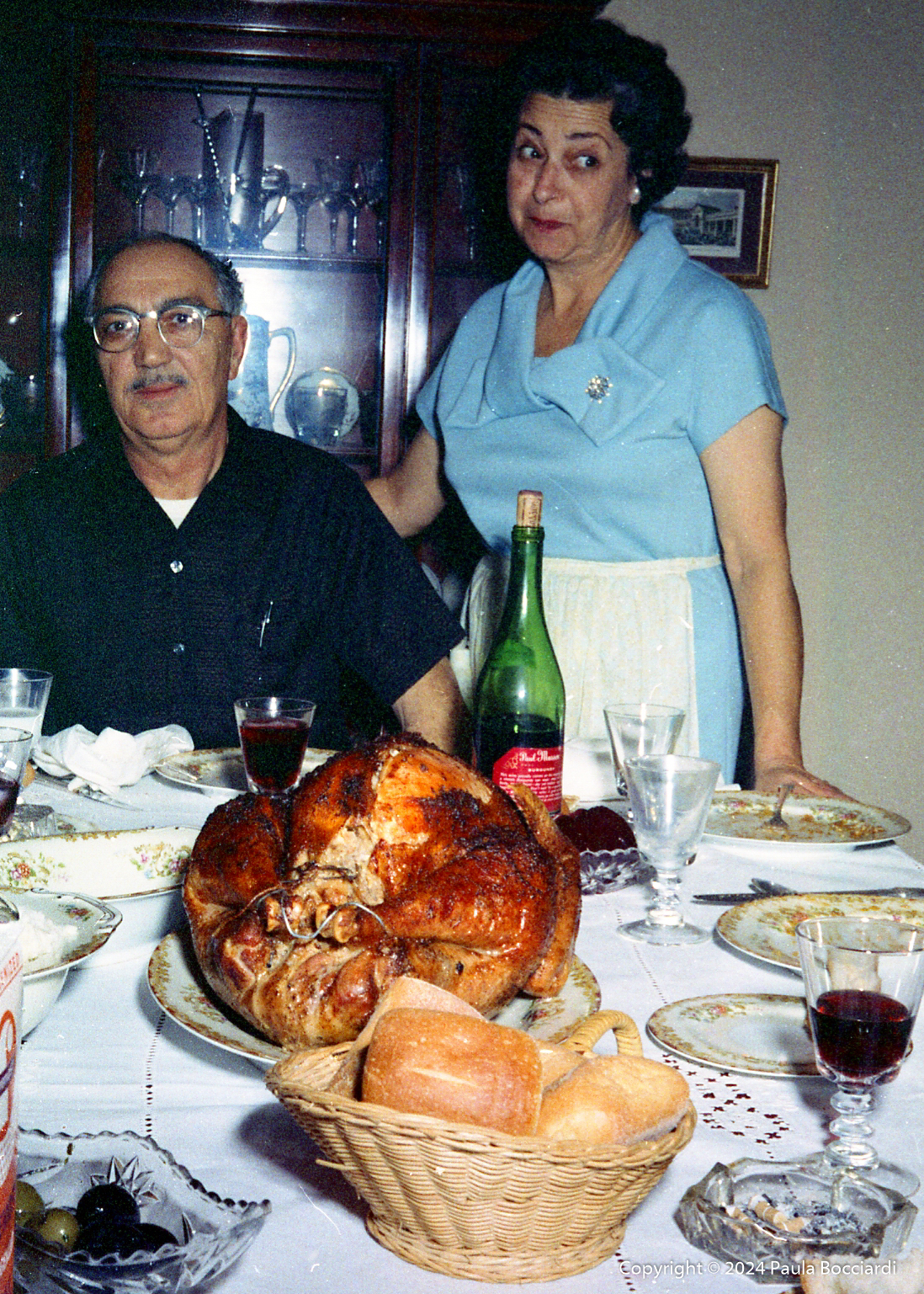
Ray and Nini

What a treasure!

The recordings from that day reveal mostly an unintelligible, piercing riot of voices. One of the most prominent voices is actually mine; I was a toddler, obviously sitting near the recorder and asking repeatedly what it was. I must have asked 10 times, with no one paying attention over the din, my voice growing louder and louder until I was screaming in frustration. 

Wire recorder

“Come fa, Babbo?  Come fa, quello lì? COME FAAAAAAAAAAAAAAAA???”

(“What is that thing over there doing, Daddy?”  I spoke only Italian in those days.)

Paula repeatedly asking what that thing was!

I was ignored, of course.

At one point my father read a poem he’d written (in Italian) about his parents’ marriage. It was both poignant and funny. At the end my aunt proclaimed, “That’s so goooood! You should send it in!!”

Where was he supposed to send it?

That line has remained with my siblings and me to this day. “Janine, your handmade card is so creative and beautiful. You should send it in!” Or “Your chicken cacciatore enters the realm of the godlike. You should send it in!”

Maybe that’s what we should be doing this Christmas: telling our loved ones that they’ve done something wonderful, and that they should send it in.

In any case, it was towards the end of the party when Nini really stole the show.

People were talking noisily about amore and kissing, and Ray had been telling a few of his slightly bawdy jokes, when his teenage son Dennis piped up.

“Ma! In 16 years, I haven’t seen you kiss Daddy on the lips yet.”

To which Nini promptly responded:

“What do you think I am, a MOVIE STAR?”

***

COMMENTERS, PLEASE NOTE:  WordPress is no longer supporting my particular page type and doesn’t seem to be asking commenters for their names, so everyone is identified as “Anonymous.” If you’re commenting (which I love!), please leave your name if you’d like me to know who you are!

***

Due to popular demand, I am including, at the end of each blog post, the latest random diary entries that I’ve been posting on Facebook for “Throwback Thursday.” These are all taken absolutely verbatim from the lengthy diaries I kept between 1970 and 1987.

December 1, 1975 [age 20]:

“I just wrote a really long letter to [my friend] Jeanne [in South Carolina], and I realize now that everything was ‘I, I, I’ all the way and it was terribly egotistical of me. I’m thinking now that my missing her so much might be just a result of my own selfishness, because she reinforces me all the time with her praise. I DO think of everything in terms of myself (but then again, doesn’t everybody?). I suppose I’ll try to be more humanitarian from now on if I can, and not so selfish. What a terrible revelation about myself!  Aak, I can’t stand it!  I hope she doesn’t think too badly of me. I’ll have to send an apologetic postcard.”

December 5, 1975 [age 20]:

“[My brother] Marc and [my friends] Joe and Ted came to the dorms today and inspected my ‘Playgirl’ magazine and said it was the grossest thing they’d ever seen. Weird – it’s okay for men to look at these things but not women. Baloney!”

December 10, 1975 [age 20]:

“I’m [my dormmate] Mike’s Secret Santa and today I gave him a note written in anagrams. (Dear future Paula: That means ‘scrambled words.’ I have a feeling my intellect is going to dwindle as the years go by.)”

December 13, 1975 [age 20]:

“Today I went to Berkeley to do research for my Film final, which is getting to be a pain in the neck. I somehow made it up on BART, caught a bus in the freezing, driving winds up to campus, and smiled all the way to the library. God! I want to go to Berkeley instead of San Jose State! Oh, if only I could go! I’d learn so much from the atmosphere alone – absorb it right into myself. I KNOW they’re all brilliant – everyone I heard talking was. Besides, all the guys had curly hair and workshirts.”

December 14, 1975 [age 20]:

“It was so painful writing my Film paper today because while walking by Mom’s chest of drawers I caught my finger on a handle and kept walking while a piece of my finger stayed on the handle.”

December 19, 1975 [age 20]:

“I watched Abraham’s story of ‘The Bible’ on TV and it was so full of faith that it practically made me repent right there.”

December 27, 1975 [age 20]: [WARNING: get out your violins and your eyerolls]

“1975 has been the year of the void. It passed by shrouded in the hypnotic boredom of duty. The first half of the year I worked continuously and the second half I spent much of my time curled up in my [dorm] room trembling at the sounds of passers-by. I’m not sure I’m going to survive this awesome grief for the past. I feel guilty about drinking and I need to start going to Mass again. At any rate, I’ve got a future I’ve got to start thinking about. To teach or not to teach. To be a cop or not to be a cop. I’ve got to make some kind of decision soon. Meanwhile, it’s the old sweet touching of pen to paper for me. Music. Novels. And all I want to do is set forth something into immortality, create some piece of magic that’ll live longer than me. And maybe help someone else live better.”

December 28, 1975 [age 20]:

“A nice, sleepy drive down to L.A. today listening to my cassettes of Bob Dylan and the Byrds. I feel so grotesque, looking at my gorgeous cousins and sister. Sometimes I wonder if I’m really a lady after all.”
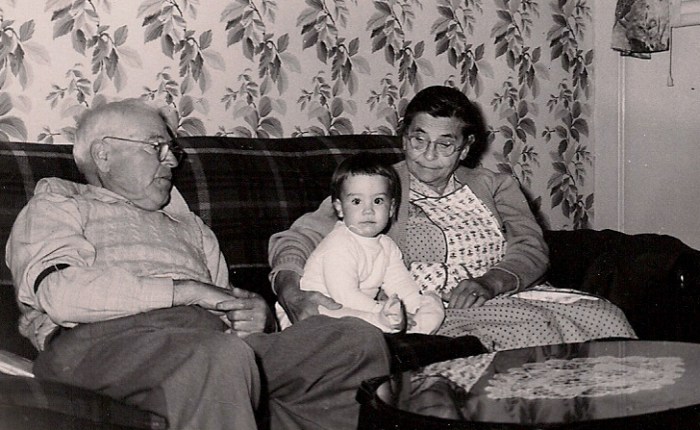
La bella vita

La bella vita

Well before dawn this coming Wednesday, city officials and a parade of fire trucks will convene downtown for the annual commemoration, at Lotta’s Fountain, of the 1906 San Francisco earthquake and fire, which killed up to 3,000 people, destroyed 28,000 buildings, and rendered 225,000 people homeless. Lotta’s Fountain was a gift to the City from Lotta Crabtree, a local actress, and it was used as a meeting place for residents after the quake. The last two survivors of the devastation died a couple of years ago, but the annual ceremony continues, beginning at 4:30 a.m. and counting down to a moment of silence at 5:12 a.m., which is the moment the earthquake struck.

My grandmother, 18-year-old Ambrogia Fontana, was one of the survivors. Newly arrived from Italy through Ellis Island, she had been in San Francisco less than a week. She spoke no English. She and her younger brother David were aiming to get a foothold in the new land, trying to figure out the people, the food, the language, the urban hustle. The culture shock was immeasurable. The two of them were asleep on Wednesday morning, April 18, 1906, when the most devastating natural trauma ever to hit San Francisco shook and burned the city. David was smashed in the head by a falling ceiling beam and was injured so badly that he was knocked unconscious and lapsed into a coma. The two of them were carted off to a tent city for quake refugees. Ambrogia had no idea where she was, where to go, or what to do, and no one could understand her. All around her, the city was in ruins.

***

Ambrogia, who was born in 1887, had grown up cutting quite a rebellious figure in the tiny northern Italian town of Staffoli, near Lucca in the Tuscan region. The oldest of 8 children, she worked in her father’s bottega (shop) where, at the age of 9, she spent her days making panini (sandwiches) while pouring a bit of grappa for herself every time she served a glass to a customer. Stern, robust, and always resentful of authority, as a teenager she would deliberately walk the streets of Staffoli wearing – gasp! – pants and smoking a Toscano cigar, just because it wasn’t done in those days.

(As an aside, Staffoli was originally in the province of Florence, but when Mussolini tinkered with the divisions in 1920 [gerrymandering!], he made Staffoli part of the province of Pisa. This would enrage my grandmother, who considered all Pisans to be thieves. The sentiment seems to endure somewhat today, and it may have stemmed from a time in history when many Pisans were tax collectors. One of my grandmother’s favorite [albeit skeevy] sayings was “Meglio che mangiare la tigna dalla testa di un cane che avere un Pisano alla porta!” [“Better to eat the mange off the head of a dog than to have a Pisan at the door!”])

Ambrogia’s father Pietro was a fairly successful businessman. In addition to owning the bottega, he was a cattle dealer, buying the animals in Milan or Venice and selling them in Florence. He also traveled extensively to Sao Pao, Brazil, where he had a coffee plantation, and to Buenos Aires, Argentina, where he owned a brewery. Rumor has it that he kept a woman in every port, and the fact that two of his children were named Brasila and America certainly nurtured the speculation.

Although he was one of Staffoli’s few wealthy residents, Pietro was, for some reason, a socialist. In fact, he periodically hosted neighborhood socialist meetings with about 15 other men – a risky proposition, given that at that time the Italian government was cracking down hard on political activists, especially anarchists and socialists. The women, of course, were not allowed to participate in the meetings. Ambrogia was required to serve the males, and she grew increasingly resentful of her father’s rigorous authoritarianism. (Little did he know that when he went off on his trips, she would gather up her younger siblings, haul a bounty of salame, bread, and a bottle of chianti up to their room, and host a food-and-wine fest on their beds!)

At one particular political meeting, at which the now-18-year-old Ambrogia was, as usual, serving, Pietro’s rigid child-rearing practices were questioned by one of his more lenient buddies. “My children,” he responded angrily, “can do whatever they want in life.” This was the moment my quick-witted grandmother seized like a snake. “Oh, yeah?” she piped up in front of everyone. “Then I want to go to America.” Shocked by her audacity, the rest of the men challenged him. “You heard her, Pietro. So you will really send your daughter to America, then,” they said, mockingly. Pietro was stuck. He had made a proclamation and he couldn’t backtrack. His ego overruled his common sense. “Sure,” he answered. His wife immediately began to cry. But it was done.

That’s how my grandmother came to find herself boarding the steamship Prinzess Irene in Genoa, Italy, on March 22, 1906. It was unheard-of in those days for a young woman to travel alone; typically, in fact, it was a household’s father or eldest son who made the voyage and then sent for the rest of the family when life was settled. In this case, though, Ambrogia’s dim-witted 16-year-old brother Davide (David) was sent with her as a “chaperone.”

PrinzessIrene2-[edited for blog]

The Prinzess Irene was a German-built ocean liner that ran on the Genoa-to-New York line beginning in 1903. She was 540 feet long and 60 feet wide, weighed almost 11,000 tons, and traveled at about 15 knots (18 mph). The ship carried more than 2,000 passengers – most of them, including my grandmother, in 3rd class or “steerage.”

Before boarding, passengers were asked to answer a number of questions, the oddest of which included whether they were polygamists or anarchists. I’m fairly sure my grandmother was not the former, but she may well have been the latter. In any case, both she and David answered “no” appropriately. They also were subject to medical examinations and to “disinfection.”

generic 1909 passport-[edited for blog]There is no way to sugarcoat the experience of the passengers in steerage. In fact, up to 10 percent of them died on the way. They sat crowded together, in the dark, under the most unsanitary of conditions. The air was chokingly foul. Five years after my grandmother’s trip, the U.S. Immigrant Service reported that “[t]he open deck space reserved for steerage passengers is usually very limited, and situated in the worst part of the ship, subject to the most violent motion, to the dirt from the stacks and the odors from the hold and galleys. . . . The ventilation is almost always inadequate, and the air soon becomes foul. The unattended vomit of the seasick, the odors of not too clean bodies, the reek of food and the awful stench of the nearby toilet rooms make the atmosphere of the steerage such that it is a marvel that human flesh can endure it . . . . Most immigrants lie in their berths for most of the voyage, in a stupor caused by the foul air. The food often repels them. . . . It is almost impossible to keep personally clean. All of these conditions are naturally aggravated by the crowding.”

In my grandmother’s case, this went on for 15 days. She and David arrived in New York on April 6. She had $25 in her pocket.

***

Three million Italians came to the United States between 1900 and 1915 during the “New Immigration” of Slavs, Jews, and Italians. Most of them were farm workers and unskilled laborers fleeing not only a politically chaotic country but also the crush of abject poverty. That was not the case with my grandmother, but it did apply to my grandfather.

Gustavo Bocciardi, a Tuscan like my grandmother, grew up extremely poor and with very little education. In April 1904, Gustavo came to America (also on the Prinzess Irene) by himself, as a teenager, in search of work. A couple of aunts in California had wired him the money to find his way out west. While on the train from Ellis Island to San Francisco, he was nearly taken advantage of when the guy at the café counter tried to charge him something like $30 for a 52-cent sandwich. As the story goes, my grandfather – short in stature, but strong as a bull – grabbed the guy by the collar and throttled him until he got his money back.

1956_07_Gustavo Bocciardi, Paula(b)
Gustavo Bocciardi (Nonno) and me, 1956

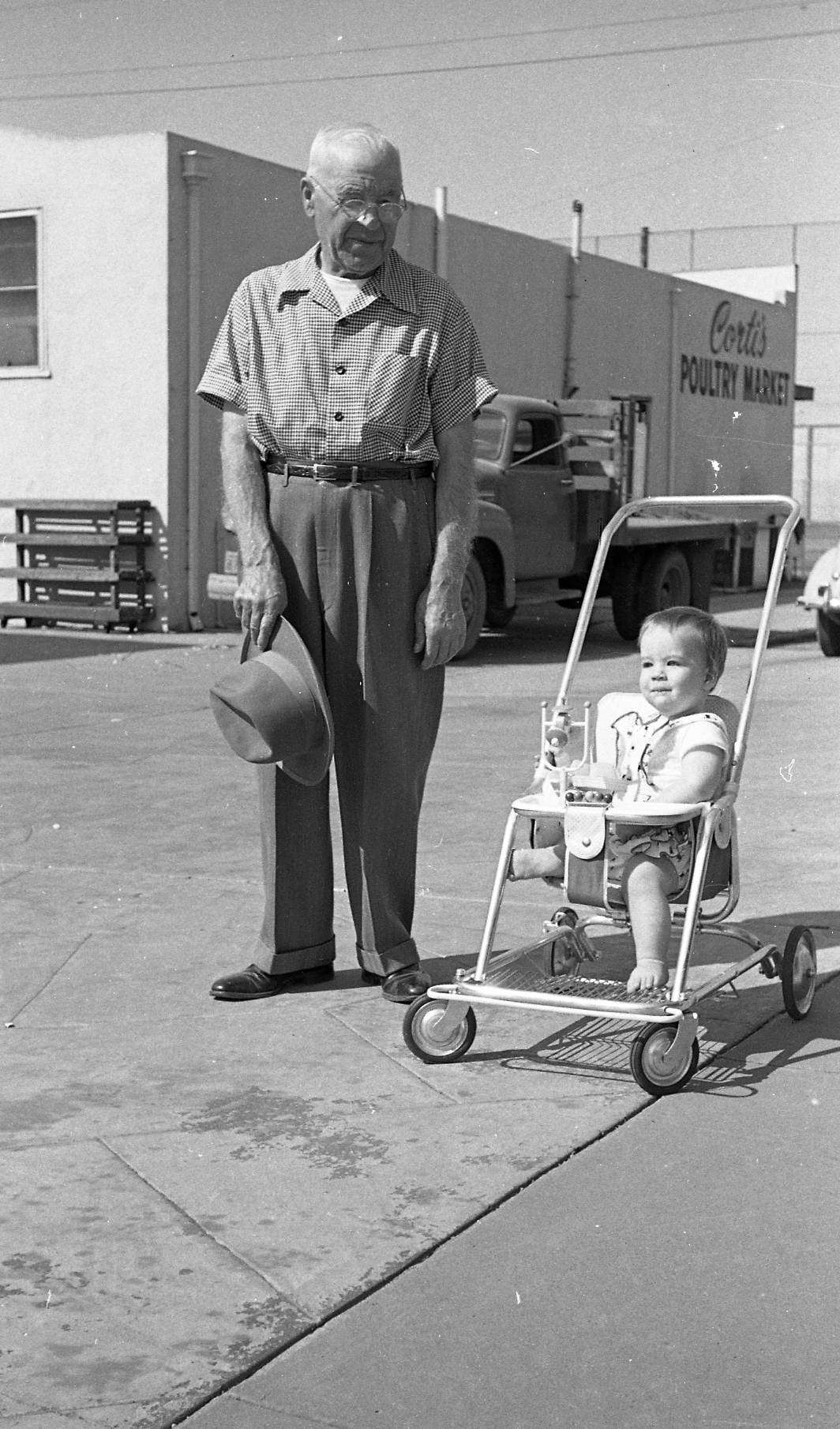
My grandfather was an interesting dichotomy. He was an emotional pushover who, in his later years, liked to push me around the neighborhood in a stroller to show me off. But apparently he had a temper – one I never, ever saw. Maybe his attitude was hardened by the bigotry that Italians regularly endured in this country. My dad told me that one day a passerby called Gustavo a “dago” to his face. “So he dropped the son of a bitch,” my father said, rather dryly. The man hit his head on the sidewalk, and Gustavo thought he’d killed him. While he was trying to explain the situation to his aunts afterwards, a police officer arrived at the door – a fellow who knew the aunts and liked them. “That guy is a jerk,” said the officer. “He’s just fine, he didn’t die, and you just tell your nephew Gustavo not to worry about it.”

***

In the few days between the time they arrived in San Francisco and the time the Great Earthquake hit, Ambrogia and her brother David had been staying in SF with their relatives the Mancinis. On April 18, the Mancinis had already gone to work by 5:12 am. – the moment the house was destroyed, and David was critically hurt – and they had no idea where their young charges were. The American Red Cross and local charities were providing food and medical care to everyone in the tent cities, which is where Ambrogia found herself, along with David, who was unconscious for days. One day, as Ambrogia was still trying to make sense out of what had happened to her, she heard Italian being spoken outside their tent. She ran out and discovered that a representative from the Italian consulate was walking around offering assistance, and she was able to tell him that she had been separated from the Mancinis, who, she knew, had relatives in Redwood City. Somehow the Consulate ended up finding the relatives and providing Ambrogia and David with transportation to their home. David would recover from his injuries.

***

By 1907, after working for a short time as a nanny, Ambrogia packed up and moved to San Leandro, a small city across the Bay from San Francisco to which many people displaced by the quake had relocated. She began working at the King-Morse cannery off of San Leandro Boulevard (now the site of the San Leandro BART station). Meanwhile, Gustavo Bocciardi – who’d been working as a logger in Boulder Creek – had also moved to San Leandro and was working at the same place.

Del Monte Cannery-[edited for blog]
The cannery
San Leandro has perhaps the greatest weather in California, and in the late 1800s and early 1900s there were plenty of farmers growing stone fruits, asparagus, and other produce in the area. The farmers made a lot of noise about getting a local cannery built to help ensure that their produce didn’t rot, and the first San Leandro cannery was established in 1898. In 1916 it became part of the California Packing Corporation (CPC), which eventually merged with the Del Monte conglomerate and became the largest fruit and vegetable canning company in the world. (Del Monte moved the San Leandro operation to the Central Valley in 1967.) The cannery employed a lot of Italians, and it was one of the few businesses in the area that provided employment to women. It was even so progressive as to offer free on-site day care. It also supplied little living shacks, for minimal rent, to some of the workers.

Gustavo and Ambrogia saw each other for the first time at that cannery. And here’s the craziest thing: they discovered that they were from the same tiny town in Italy! And they hadn’t known each other! I don’t know the population of Staffoli back then, but even now it has only a few thousand people. I can’t imagine how they could not have run into each other, especially because they were only two years apart in age. But my grandfather was poor and uneducated, and my grandmother traveled in a different universe.

Not surprisingly, Gustavo and Ambrogia ended up getting married, in Oakland, on December 30, 1907. A year later they had their first child, my aunt Nini, whose real name was actually Maria. [Ed’s note: every Italian family has a Maria!] My grandfather apparently won the naming rights and chose to name my aunt after his grandmother Maria, even though my grandmother – who was very anti-clerical (but not anti-religious) at the time – emphatically insisted that the Biblical Maria (Mary) was “the world’s first whore”!

1916_(L to R)_Giannina Corti, Gino Corti, Rizzieri Matteucci, Gustavo Bocciardi, Marie Bocciardi, Ambrogia Bocciardi-[edited for blog]
Gustavo (sitting) and Ambrogia Bocciardi, with daughter Maria (Nini), 1916
My aunt Nini – who was loud and very funny, often unwittingly – used to tell us that she was “born dead.” That declaration always amused and puzzled us kids, but my mother explained that although the doctors did initially pronounce her dead because she wasn’t breathing, she suddenly took a gasping breath and that was that. Nini slept, as an infant, in a dresser drawer, and when she was a month old my grandmother took her to work with her in a shoebox. They were all still living, at the time, in a cannery shack.

What continues to amaze me to this day is that my indefatigable grandmother found an additional way to make money. At night she would cook up an abundance of food that she could feed at lunch the following day to the many single young men who worked alongside her at the cannery: stews, chicken in sauce, etc. In the morning she would set the table, and at noon she’d race home to heat up the food. Then the cannery workers would come over and buy lunch from her to eat while they rested! How she did all this and cared for a baby, I do not know. She was strong, smart, and determined. It didn’t matter that she had been brought up in a family of means. She was on her own now, and she had no expectations of being handed anything anymore. She could stand on her own two feet. And hold everybody else up as well.

***

San Leandro ballpark sign-[edited for blog]At some point my grandmother quit the Cannery and they rented a house in San Leandro. Gustavo then worked at a variety of jobs – lumberyard, sawmill, munitions factory during World War I, etc. – for a few years each until his hot temper got him kicked out. Finally, nearly 20 years later, they could afford to have their first home built in 1926, right across the street from the San Leandro Ballpark (adjacent to the cannery) where my father says he saw Billy Martin play before he made it into the majors. Tickets to the Sunday afternoon baseball games cost 15 cents for gentlemen and 10 cents for ladies. What a steal! (That field, which I remember well, is now long gone, demolished when the BART station was built.)

By then my grandfather had gotten into the poultry business, and eventually he established his own market with two other guys – one of whom was his new son-in-law Ray. My grandparents weren’t keen on Ray because he was, irony of ironies, a Pisan! And true to stereotype, Ray’s father was a crook – a bootlegger who somehow cheated my grandfather out of a lot of money, although no one quite remembers how.

1925_San Leandro_Gustavo Bocciardi in Dodge truck-[edited for blog]
1925
***

Nearly nineteen years after Maria was born (yes, you read that right), along came my father in 1927. He was almost named “Sbaglio” (“Mistake”) because my grandparents had been convinced that they were too old to have children. In fact, once she started to show, my grandmother went to the local pharmacist to ask him what to do for her “tumor.” His reply? “That’s no tumor, lady. That’s a baby!”

Dad once said that they should have named him “Tumor.”

1937_12_Dad, Gustavo and Ambrogia Bocciardi-[edited for blog]
Gerald (my dad), Gustavo, and Ambrogia Bocciardi, 1937
My father had a wonderful childhood in San Leandro, in what he calls “the Italian ghetto.” He was adored and spoiled and many of the neighbors spoke Italian (or Spanish or Portuguese) and everyone watched out for each other. When he ran home from his first day of school because he couldn’t speak English, my grandmother ushered him right back. Her children were going to make something of themselves, and they would have an easier life.

***

1956_11-19_Gustavo Bocciardi, Paula(b)
Nonno and me, 1956

I’m only half Italian, but nearly all of my historical and cultural understanding of my heritage came from that side of the family. The German relatives on my mother’s side were almost guarded about their ancestry. But the Italians were proud and joyful.

My first language was actually Italian. I didn’t know how to speak English until I was about three years old and my maternal grandmother was babysitting me one day, couldn’t understand my repeated requests for acqua (water), and implored my parents to for God’s sake teach me some English.

1956_07_Mom, Paula, Ambrogia Bocciardi(b)-[edited for blog]
Beverly Bocciardi (Mom), me, and Nonna, 1956
When I was a child, I had the great fortune of spending at least every other weekend at my grandparents’ house in San Leandro. Nonna (my grandmother) wore aprons all the time and was constantly at the stove. Nonno (my grandfather), as I mentioned before, pushed me around in my stroller and visited all the neighborhood ladies. He let me help him pick vegetables from their perfect garden and dig for treasures in their basement. The Southern Pacific Railroad ran two lines near the house because the cannery depended on trains to bring in produce and ship out the canned goods. In the middle of the night the house would shake and rumble and the train whistle would practically wake the dead as the “choo-choo” thundered by. I loved the comfort of it.

1957_09_Marc's Baptism_Paula, Gustavo Bocciardi, Marc 1(b)
Nonno with me and my brother Marc, 1957

***

What great resilience and fortitude the immigrants had. How did those people from quiet little towns – some of them teenagers, like my relatives – find the courage to leave their homes and families and travel in horrid conditions across an ocean without knowing whether they would even survive the journey or, if they did, what they would do when they arrived? Most of the time they would end up sacrificing everything for their own new families in America. And yet, despite the prejudice and the barriers, they did it without complaint. Without defeat. They were heroes without monuments.

One of my very favorite movies, Mi Familia, ends with a scene in which the mother and father of an immigrant family from Mexico sit at a table and reflect back on their lives. The mother had suffered terribly getting to this country as a young woman. Their oldest son had been murdered. Their daughter-in-law had died soon after giving birth. But ultimately their remaining children and their grandchildren had found their way in life. As the parents savor their coffee and reflect on their marriage and family, José says, “Maria, we’ve had a good life. We’ve been very lucky.”

She nods but then pauses. “It would have been even better if . . . .”

But José won’t hear of it. “No, Maria, don’t say it,” he says. “Don’t even say it. It is wrong to wish for too much in this life. God has been good to us.”

“You’re right,” Maria says. “We have had a very good life.” And they kiss.

Sometimes I wonder what my grandparents would say if they knew what the world was like today. How could they comprehend people pulling out guns and shooting up schools and workplaces because they’re frustrated that things aren’t going quite perfectly for them?

And what would they think about those of us who show off pictures of our own food? How self-important have we become?

And how high are our expectations about the happiness we think life owes us?

Ambrogia and Gustavo lived in their little white San Leandro house for the rest of their lives. It was a simple existence, but they provided their two children with everything they needed: love, support, and education. My grandparents worked hard and had no time to be self-important. Life wasn’t easy. But they were self-reliant and they were happy. They talked, they laughed, they loved, they ate, and they drank with gusto.

And even when they were practically penniless, they were rich with courage, culture, and ideals.

It was the good life. It was la bella vita.

Salute, Nonno and Nonna. Vi voglio bene. I will love you forever.

1949_Ambrogia Bocciardi(a)-[edited for blog]

***

Due to popular demand, I am including, at the end of each blog post, the latest random diary entries that I’ve been posting on Facebook for “Throwback Thursday.” These are all taken absolutely verbatim from the lengthy diaries I kept between 1971 and 1987.

9/24/71:

“6th period I have Geometry with Miss McCulloh. I always get done before everyone else in there. She said kiddingly, “I’ll have to give you extra work.” Well, brother, I have had enough of THAT before!”

10/26/71:

“I had to stay home from school today because I was sick. What a bummer! I’ll have to miss tennis tomorrow. Shoot! Not much else to say. I watched Graham Kerr [“The Galloping Gourmet” on TV] make poached eggs in wine sauce. Then I got hungry so I went up and had lunch. I had green-pea soup, a salami-ham-cheese sandwich, potato chips, an apple, a Ding-Dong, and a Coke.”


Christmas, 1967:

“Today we went to Church in our red plaid Scottish skirts and blouses and berets. The blouses were wool blue and so were our sweaters. Janine and I were scared with our berets.”

My heart’s still here . . . .

My heart’s still here . . . .

I’ll never forget the night I was sound asleep in my San Francisco apartment when the phone rang and a friend of mine demanded that I leap out of bed and rush immediately to the Symphony.

I had just started work for the state Administrative Office of the Courts, at a job I thought would be temporary but, as it turned out, lasted 26 years and netted me a pension. We worked only until 4 p.m. in those early days (ah, the 80s!), and my new co-workers told me about their “tradition” of periodically heading out to the Cliff House bar after work to quaff a few on a Friday night. I happily agreed to go along, and that night they introduced me to the delightful but merciless beverage called the Long Island Iced Tea. This insidious assassin of a drink contains five different alcohols, with a little Coke thrown in for good measure. I certainly hadn’t been a teetotaler up to that point – far from it – but I had no idea what that drink was. The very first sip was absolutely delicious – it tastes, of course, like iced tea – so I downed a tall one and then ordered another, unaware that the copious amounts of hidden alcohol in that lovely amber cocktail could kill a horse. About halfway through the second one, I realized that I couldn’t feel my feet.

So I stopped drinking and left for home, probably on a bus, because I’m sure I wasn’t driving. It was only about 6:30 p.m., but of course the minute I got home I decided it was time for bed.

I was already slumbering soundly when my friend Kay called. She worked as a marketing person for the San Francisco Symphony and had two tickets for the Symphony that very same night. In about an hour. Insisting that I go with her, she wouldn’t take my protestations seriously. “Good God, Kay,” I groaned, “I’m already in bed! My contact lenses are being disinfected and I already have my retainer in! And I’m sure my hair by now is a rat’s nest. Plus I just drank the equivalent of four liters of alcohol and can’t feel my feet! Forget it.” But one of Kay’s gifts was the power of persuasion, and for some reason I acceded to her demands and dragged my sorry self wearily out of bed.

I hardly had time to get dressed, but I managed to pull on some nylons, the only dress I owned, the only shoes with heels I owned, and the only coat I owned, which was a London Fog raincoat, even though there wasn’t a cloud in the sky. I thought I should try to look elegant.

Mind you, I was not a Symphony type of gal. In addition to rock and roll, I definitely loved Big Band and the great American crooners. But to a great extent I’m a cultural philistine, and I keep my distance from the refined arts. So I had never been to the Symphony or the Opera and had intended to keep things that way. Still, I had heard a few classical pieces and thought to myself, “Well, some of that stuff can be rousing and might get my adrenaline going. How bad can this be?”

I’ll tell you how bad. What I didn’t know until the music started was that I was in for an evening of ancient chamber music, performed by a string quartet. Four people with violins on a stage. The best way I can describe the entire night is that it went like this:

Plink.

Plink.

Plink.

With an occasional:

Plunk.

Needless to say, it was neither rousing nor inspiring. It finally got to the point where, much to my amusement, I thought I heard the older gentleman next to me sawing logs. Then a loud snort came out of me and I realized, to my mortification, that I was the one who’d been snoring.

***

When Kay drove me home after the evening mercifully ended, I told her in no uncertain terms that she owed me BIG TIME. What I demanded in return was that she get us two tickets to see Tony Bennett when he appeared with the Symphony later that season. She thought I was joking. “Tony Bennett?? You’ve got to be kidding me. That old guy? What are you, a senior citizen?” But I would not back down. I loved the man, and she was going to take me to see him. She teased me about it for months and proclaimed my uncoolness to all of our friends, but I kept my resolve and won.

***

I had been a Tony Bennett fan for nearly my entire life. When we were kids, my mother kept a radio on top of the refrigerator, and it was on KABL night and day. Mom was first and foremost a Sinatra fan, but she certainly loved and appreciated all of the sophisticated adult (i.e., non-rock) music of the time. I absorbed all of it.

Sinatra, I thought, was an actor as much as a singer, and his style could practically conjure a feature film out of every song. Perhaps because of my age I wasn’t a fan of his woeful laments like “In the Wee Small Hours of the Morning” that he recorded when Ava Gardner was about to leave him. But I adored his big-band and swing tunes, Sinatra at the Sands with the Count Basie Orchestra being an album I could listen to every day.

Tony Bennett, to me, was jazzier and less mercurial. He didn’t have Sinatra’s urban rakishness, but his voice was so good that flair was unnecessary. He could do ballads and he could do swing, with equal weight. He was never breezy. His voice had a hint of Italian huskiness to it, like a little bit of peppery seasoning on a tender filet.

Sinatra famously said Tony Bennett was “the best singer in the business.” Is there a greater endorsement?

***

Anthony Dominick Benedetto was born in Queens, New York, in 1926. He studied music and painting in school but dropped out at the age of 16 because his family needed the financial help. During World War II he served on the front lines with the U.S. army infantry – an experience, by the way, that spurred him to become a lifelong pacifist. After the war, he decided to study singing and acting. Pearl Bailey discovered him in Greenwich Village, Bob Hope put him in his road show, and Columbia Records signed him in 1950. Lucky for us. Since then, he has sold more than 50 million records.

Tony’s life wasn’t without its problems. When music labels began demanding that singers record rock albums in the 1970s, he hated compromising his principles so much that he apparently would get sick before recording sessions. The rock records didn’t sell. His second marriage dissolved, his lack of business savvy brought him to near financial ruin, and he got involved with drugs. Fortunately, his son Danny helped him completely resurrect his career. He got Tony booked on “MTV Unplugged” in 1994 and exposed him to a hip, younger crowd. The Unplugged album from that show won the Grammy for Album of the Year, and Tony was hot again.

Tony Bennett is a gentle man, happy and grateful, with an artist’s sensibility and an abundance of class. He walked with Martin Luther King in the Selma-to-Montgomery marches. He’s an accomplished painter whose works hang in the Smithsonian. His paintings have been commissioned by the U.N. and he was named the official artist for the 2001 Kentucky Derby. He is tirelessly involved with a host of charities. He and his wife founded Exploring the Arts (which promotes arts education) and the Frank Sinatra School of the Arts in Queens, a high school dedicated to performing arts instruction. Right now he’s in the middle of a tour that runs at least through November and includes a show next month at Radio City Music Hall in New York.

On August 3, he turned 90 years old.

***

Most people don’t know that “I Left My Heart in San Francisco” was written in 1953 by two gay World War II vets, George Cory and Douglass Cross. They lived in New York City after the war but strongly missed what George called “the warmth and openness of the people and the beauty [of San Francisco]. We never really took to New York.” They moved back to the Bay Area in the late sixties, and three years after Douglass died suddenly of a heart attack at the age of 54, George took his own life. The coroner’s office reported that he was “despondent over failing health,” but I wonder about his broken heart.

After it was written, “I Left My Heart” languished until late 1961, when Tony was looking for a song to add to his repertoire while he was on tour. Not even realizing that the tune would be a hit, he sang it for the first time in December 1961 at San Francisco’s Fairmont Hotel, where his tour culminated.  He recorded it in January 1962 and it was released as the “B” side to “Once Upon a Time.” The rest is history. It won the Grammy award for Record of the Year, and Tony won for Best Male Solo Vocal Performance, his first Grammy.

San Francisco adopted “I Left My Heart in San Francisco” as the city’s official song in 1969. In 2001 it was ranked 23rd on the “Songs of the Century” list compiled by the Recording Industry Association of America and the National Endowment for the Arts.

***

2016_08-19_Tony Bennett Statue Dedication_2

On Friday, August 19, San Francisco organized a huge celebration for Tony by unveiling a statue of him in front of the Fairmont Hotel. The Giants game that night was dedicated to him as well. I had decided months ago to attend both events, and I was determined to follow through with the pledge, despite the fact that I was suffering from vertigo.

(Yes, I’ve been dealing with dizziness for about three months, on and off, and am not happy about it. It’s become clear that it has something to do with my ears – so I probably don’t have a brain tumor, which is always my initial assumption – and I’m going through the process of getting medical attention. But I’ve been living in a disoriented fog of dizziness, nausea, and general ennui on and off since May. It was so bad last week that I wasn’t able to work on my blog because I just couldn’t focus. I hated not posting something, but it also made me realize that there is no way I can come up with 52 good ideas a year anyway! So now I am reconciled to the fact that Monday Morning Rail won’t be published every single week. At least my misery has resulted in a revelation.)

Anyway, that Friday morning I found myself walking up Powell from Market Street towards the Fairmont. It may not have been the best choice of routes, because in that area Powell Street is so steep that you practically need climbing gear trying to summit it. I was huffing up the street at a pretty good clip, though, silently congratulating myself for being in such decent shape after not having exercised in many weeks because of the *&^%$# vertigo, when I looked to my left and a young woman and her three-year-old child went skittering past me up the hill like a couple of mountain goats.

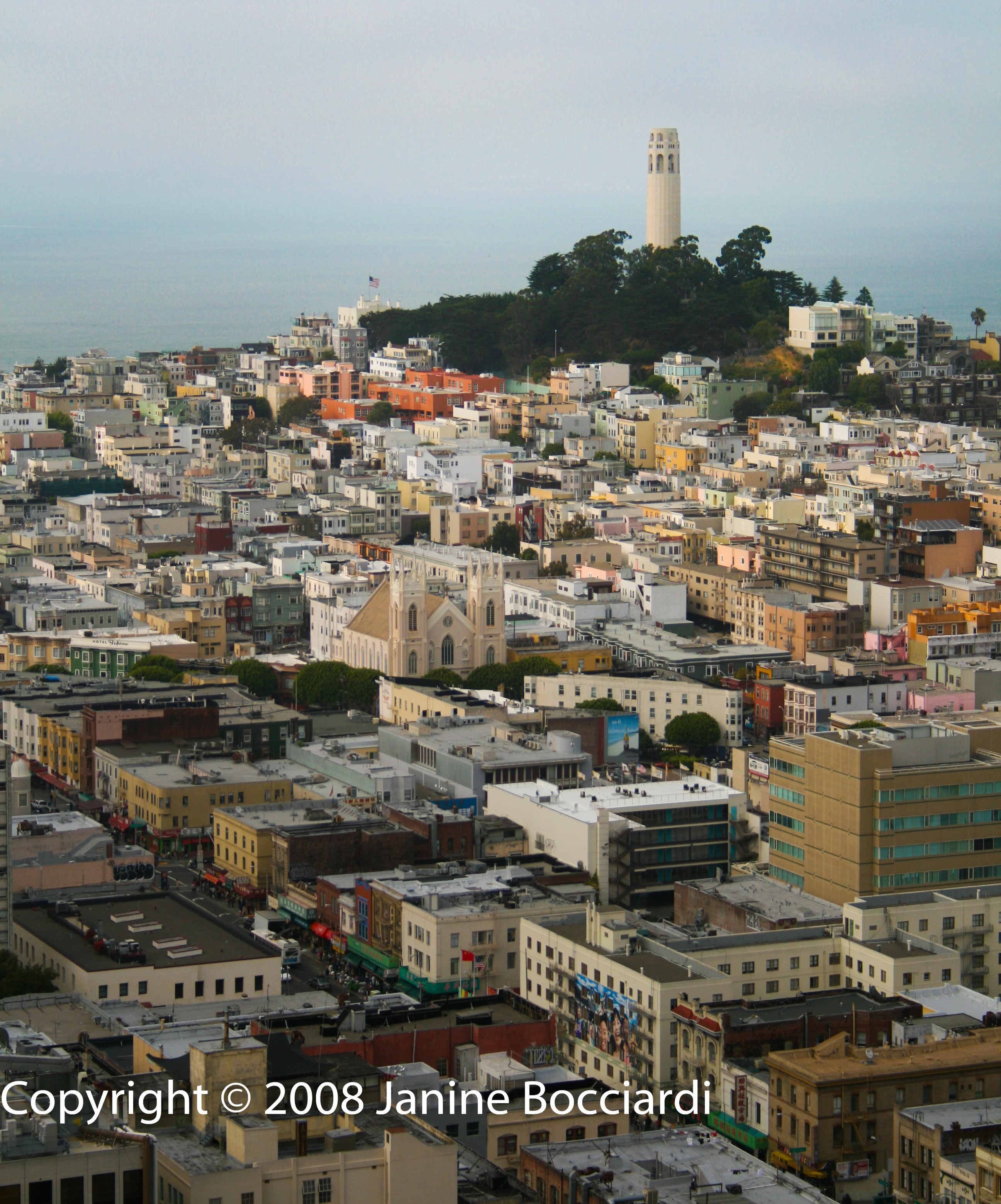
I could probably write a 100,000-word love letter about San Francisco, and maybe I will someday. The subject, though, is probably much too broad and much too emotional for someone like me to adequately capture. I would undoubtedly lapse into clichés or drunken sentimentality. But let me just mention that the two hours I spent in front of the Fairmont were arresting. The fog, of course, was hanging over us, somewhat lightly, but enough to keep me cool in the almost constricting crowd. There were tourists, residents, babies, parents, old folks, and people of all colors. The bells of Grace Cathedral were ringing melodiously and with grandeur. The San Francisco Chief of Protocol (I love that quaint designation) spoke, as did the mayor, and Nancy Pelosi, and Dianne Feinstein. Behind the blue birthday balloons – some of which were lurching and popping in the wind – the Fairmont’s procession of international flags lined its historic façade. I was thinking about the Fairmont and how it survived the 1906 earthquake, and how I loved the hotel’s tropically decorated Tonga Room and its thatch-covered floating stage and its exotic drinks, and how the Fairmont had been the site of our wedding reception and I had actually, truly, gasped when I first saw the view from the room. About then, a cable car stopped behind us and remained there for the ceremony, the conductor ringing its bells periodically with great spirit and joy.

View from Fairmont
The view from our reception room at the Fairmont, 2008

Three very elderly women were standing behind me, and I could tell that they were native San Franciscans – probably Italians. They spoke with a classic San Francisco accent, and yes, there definitely is such a thing among the old-timers. My cousin Jerry, who was born in San Francisco, used to speak with a combination of Boston and New York accents – an articulation cultivated specifically by the Irish and Italian Catholics who lived out in the Mission District. Sure enough, when one of the speakers joked that the world is divided into people who are Italian and people who want to be Italian, the ladies cheered. I knew it! Anyway, these women were about 4-1/2 feet tall at best, all dressed to the nines. And they had that unselfconscious way of speaking their mind and not caring who is in earshot – common to the elderly, I think. “The papers said this ceremony was going to be on the Fairmont lawn,” one of them declared loudly. “There’s no lawn at the Fairmont. What a bunch of crap!” She was right about that. When Dianne Feinstein came out to speak, one of them sucked in her breath at what she must have considered a fashion faux pas. “Oh, my,” she hissed, “can you believe she’s all in red?”

The sun finally broke through the fog, with its usual good timing. Tony Bennett walked out to much applause and his huge statue was unveiled, depicting him with his head thrown back and arms raised upwards, singing with great heart, as he always does. The real Tony choked up and told everyone, “You have been so wonderful to me. I’ll never forget this day.” I felt embarrassed to be fighting back tears myself, but I stole a glance at the young man beside me and he was sobbing!

***

2016_08-19_Giants Tony Bennett Night_3

That evening, Julie and I took the streetcar out to the ballpark for Tony Bennett Night. Tony didn’t sing, but he said a few words. The entire stadium sang “Happy Birthday” to him. I had a crab sandwich on sourdough.

2016_08-19_Giants Tony Bennett Night_1

After every Giants home victory, “I Left My Heart in San Francisco” is piped over the public address system at the ballpark. While most people file out of the stadium, I always stick around to listen to the song. For those three minutes, I relish not only the victory but my great fortune to have spent a lifetime loving both Tony Bennett and San Francisco.

That night, the Giants won 8-1.

***

You know, something else sticks with me about the day. Mayor Lee made a point of saying that while the city is facing new problems that need to be resolved soon, “we also need to celebrate what is right and what is great about San Francisco.” To me, everything about that day was right and great.

The courtship of Paula’s father

The courtship of Paula’s father

When we were kids, my brother Marc and I decided to torment our younger sister Janine by claiming that we could speak Romanian.

To bolster this claim, we produced a letter allegedly sent by the Romanian Language Division of local pop/radio station KLOK. Dated June 13, 1969, the letter informs me that Marc and I were among 23 listeners who had participated in the station’s broadcast of Romanian language lessons and that we had scored very highly on the final exam.

It could be said that I myself wrote that letter, although it was signed by one Nicholai Jansek. If that isn’t a Romanian-sounding name, I don’t know what is.

For some reason, not only did we claim to speak Romanian (which required that we utter complete gibberish to each other), but we also claimed to be able to sing in Romanian. The song we selected as proof was Simon and Garfunkel’s “Feeling Groovy.” In Romanian, the last line of that song is apparently “Sah-bay ding-dong!”

My sister bought it.

Romanian is one of the five most common Romance languages (along with Italian, Spanish, French, and Portuguese). They all evolved from Latin, and they are the most beautiful languages in the world.

I bring this up because I was thinking about both romance and language the other day. I’ve been slowly going through my mother’s things since she passed away a few months ago, and when I was looking through her wedding album, a diary entry caught my eye. Although we all knew that Mom and Dad had eloped to Reno 64 years ago this month, I’m not sure that anyone knew they had been arrested along the way. At least, that’s what it says in my mother’s matter-of-fact entry:

“Saturday, May 10, 1952: We departed from San Leandro, California at 10 a.m. Arrested for speeding at 10:30 a.m. Arrived Reno, Nevada at 2:30 p.m. Car vapor-locked; delayed forty-five minutes. Married 5:20 p.m., county courthouse. Telegrams sent to parents, 6:00 p.m. Dinner at Riverside Hotel at 7 p.m. Gambling in the evening until 11:00 p.m. Bride won, groom lost.”

Gerald Raymond Bocciardi and Beverly Jane Steger met in the fall of 1951 at the University of California at Berkeley. Twenty-five-year-old Gerald was heading towards his Ph.D. in Romance Languages and was teaching Italian II. He had grown up in San Leandro, the first-generation son of Italian immigrants, and had started school without knowing a word of English. But he was soon proficiently bilingual, and by the time he was a couple of years into his stint at Berkeley, he was a multilingual scholar. For some reason, he had originally signed on as a pre-med student, but as my mother tells it, he would “faint at the sight of a bloodshot eye” and soon realized that his calling was elsewhere. He got his master’s degree but never finished his Ph.D. because, after getting all the way through the coursework and the oral exams, he couldn’t bring himself to write the dissertation. “It’s just nonsense,” he told me once. “I didn’t want to spend a year researching Petrarch’s pubic hairs.” The man had a way with words.

Beverly, born in Wisconsin and raised in southern California, escaped a fairly loveless household when she made her way to Berkeley. The Stegers had an unhappy marriage, and they were stoic and demanding parents who never hugged their two daughters or told them they loved them. Despite her environment, however, Beverly knew no better and would have stayed at home had she not gotten a scholarship to the University of California at Berkeley. She was a strong student and a professional-caliber athlete. But she was also quite provincial, and she was worried about moving to such a cosmopolitan city. Of course, as life goes, it turned out to be the best thing that ever happened to her.

That September day when Beverly sat down in Jerry’s classroom, he felt – for the first time ever – love’s mysterious and feverish joy. He was smitten with her beauty, her freckles, and her impeccable pronunciation of the Italian language. She seemed to be everything his unformed self had ever wished for. So he would gallantly light her cigarette in class (yes, it was the 1950s!). And he would frivolously call her up after class to discuss homework. But there was nothing more he could do; he was, after all, her teacher, and though there were no written rules about consorting with students, he was a man of ethics.

Until, that is, one day when another instructor had to depart suddenly for Italy to care for an ailing mother. The department’s teachers were hastily rearranged, and Jerry announced to the class on a Friday morning that he was being transferred out. That night, he called Beverly for a date. On Monday morning, Jerry was miraculously teaching Beverly’s class again. Somehow he had finagled a way to get back in. But he had already asked her out, so his ethics – however shaky – were intact.

On date 1, Jerry took Beverly to San Francisco to see An American in Paris and have dinner in North Beach. They got back to Bev’s Berkeley dorm at 7:45 p.m. – 15 minutes after curfew. Bev, who had to beat on the door and be let in by the “house lady,” was “campused” (grounded) for her transgression. Jerry was mortified and sent red roses to her every day for a week. Flowers lined the hall, filled the bathroom, and ended up in other girls’ rooms because the whole place began to look like a hothouse.

On date 2, Jerry took Beverly to the very fancy Sainte Claire Hotel in San Jose. Beverly, who had never had hard liquor in her life, made the mistake of ordering a Tom Collins. She drank only half of it before getting violently ill. Still, on the way back to Berkeley, Jerry cheerily announced that they would take a “little detour” to San Leandro so she could meet his parents. Beverly hung her head out the window of that little Nash Rambler all the way back. It took a while to make the trip in those days, on the slow backroads, and the bracing fall air must have cleared her head, because she ended up making a lovely impression on Gustavo and Ambrogia Bocciardi. When she returned to the dorm and mentioned the “little detour,” her friend Hjördis – from Sweden and eminently more sophisticated – issued a prescient warning: “Uh, oh. You’re stuck. When you meet the Italian parents, you are hooked for life.”

On date 3, Jerry took Beverly to the Grand Lake Theater in Oakland and then to an observation point in the Oakland hills, where he finally got up the nerve to kiss her. He then immediately asked her to marry him.

Beverly laughed out loud at the insanity of it and initially turned him down. But they would be married within a few months.

They were making plans for the wedding one day, and drawing up the guest list, when Beverly started to cry. With the Italians, you know, you have to invite Uncle Lorenzo’s barber and the next-door neighbor’s live-in boarder, and the list was growing and the Stegers were refusing to pay (they wanted cake and punch for 12 people, not anitipasti and ravioli and lamb for 212), and the Bocciardis had no money, and the Italians were complaining about the wedding being in southern California because none of them had been on an airplane before and God forbid they get in cars and drive, and the whole thing was getting to be a fiasco. So Jerry suggested they elope to Reno and have a tiny little church wedding later, and Beverly breathed an enormous sigh of relief.

They jumped in the car as soon as the weekend came because they just could not wait a moment longer. It was a different time. There is no doubt in my mind that they were both virgins. They were both good, chaste Catholics. But they also loved and fervently desired each other, and I’m sure those tires left skid marks peeling out of San Leandro that Saturday morning. Hence the “arrest” for speeding just half an hour into the trip.

My mother and father had an absolutely storybook marriage. In their early days, they lived on and off with Gustavo and Ambrogia in their tiny house in San Leandro. “Groom’s room remodeled by bride,” Beverly wrote in that wedding album. “Improvement is indescribable.” Beverly shadowed Ambrogia, learned about olive oil, prosciutto, parmesan, and chianti, and laughed all day with my grandmother over stories about the Old Country. My favorite was about an Italian relative who named her child Ultima (“last”) because she didn’t want any more children; she then proceeded to have three more, and when she finally pilgrimaged to Lourdes to pray that her fertile days would end, she got pregnant while she was there!

Jerry spent his days at Berkeley earning his secondary teaching credential, his weekends working side by side with Bev at his father’s poultry business, and his evenings on the porch, writing poetry for his new wife and chewing the fat with every Italian and Portuguese neighbor who passed by.

Those were the days of wine and roses.

***

I was thinking about what makes marriages work. Some people say that it’s best not to get married young; after all, people can change dramatically, and it’s hard to know, at age 19, who you really are.

But in my parents’ case, their youth was a gift. When they looked at each other, they were exhilarated.

None of us really knows, when we first settle in with a friend or lover, how well our hearts will mesh through the years. I actually believe that the key to a successful marriage is a lot of luck. My father could not have known, when he met my mother, that she was his perfect complement. He was a brilliant man, but there were few practical things he could do outside of teaching. My mother was the household engineer; she knew what to do with a plumber’s wrench and how to fix a carburetor. She hand-made all of our clothes, handled the finances, whipped up delicious multi-course meals when my father brought school administrators home on the spur of the moment. She went shotgun-shooting with Dad and learned how to fish. And she immersed herself completely in the culture of his family.

And Mom certainly could not have known that Dad would lead her gently away from her lonely childhood and bring her into an Italian family that shouted their love of each other to the rooftops. They were loud, funny, embracing, hungry. It must have been like a dream for her – all that adoration and attention. One of my father’s favorite memories that he told me repeatedly – even in the throes of the Alzheimer’s that would eventually claim him – was that one time his mother was rolling out some pastry dough, and she looked up and said to him, “See this dough, Jerry? If I were to try to make, with my own hands, someone who would be the most perfect wife for you, I could not even dream up someone as wonderful as Beverly.”

(Or, as she pronounced it, “Bebboli.”)

And throughout his entire life, my father demonstrated to my mother what devotion and romance really are. When we were kids, he used to write poems about her upper arms. Sometimes they were in English and sometimes they were in Italian. He would write them on the spur of the moment on a tiny piece of paper that he would fold up and ask one of us to deliver to her. I used to wonder if maybe “upper arms” was a euphemism for . . . well, you know. But no, he just thought her upper arms were magnificent. She saved all of those poems. We found them when we cleaned out their house.

***

In 2004, when I was still working for the Administrative Office of the Courts, I did an interview with Judge Al Delucchi, who had been assigned to preside over the Scott Peterson capital trial. As I began to ask my first question, the judge stopped me and said that he first needed to know one thing. “Is your father by any chance Professor Gerald Bocciardi, who taught at UC Berkeley?” When I said yes, he said that he had been one of Dad’s students. “And my guess is that your mother was in that class, too,” he added with a chuckle. He was remembering back 53 years. That was the impression my parents made.

My beautiful, beautiful parents. ›››››

Romanian certificate